
Education Loans
Terms Used in Education Loan: 30+ Important Terms Every Student and Parent Must Know
ShikshaVahini Team · 17 September 2026 · 6 min read
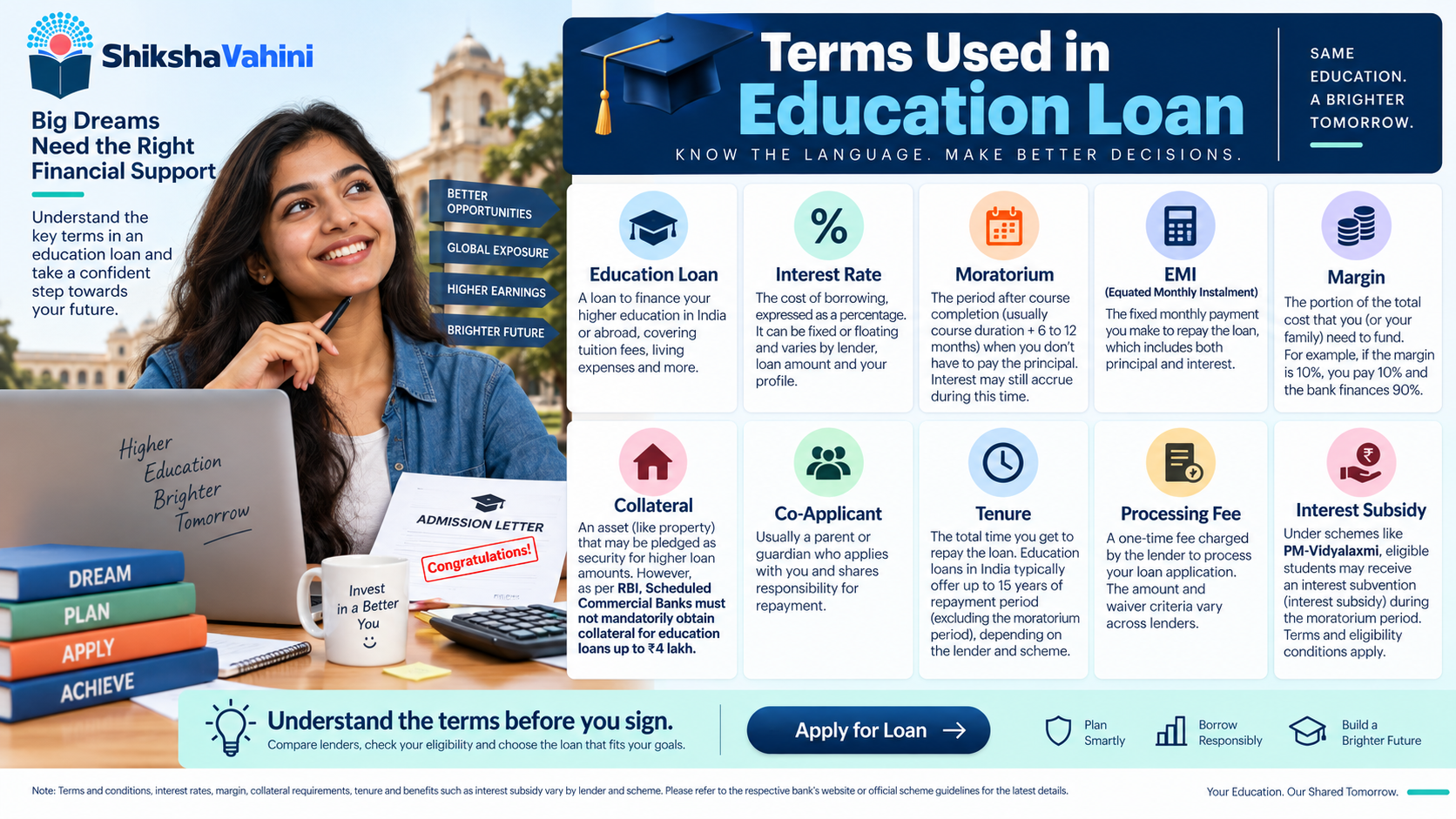
Understanding education loan terms like EMI, interest rate, moratorium, margin, collateral, co-applicant, tenure and interest subsidy helps students and parents make informed borrowing decisions. This guide explains these key terms in simple language so you can compare loan options, understand repayment costs and choose the right education loan confidently.
Terms Used in Education Loan: 30+ Important Terms Every Student and Parent Must Know
Imagine this.
You have finally received the admission letter you were waiting for.
The college is reputable. The course is exactly what you wanted. The career prospects look promising.
Then comes the next question:
"How are we going to pay for it?"
You approach a bank and hear words such as margin, moratorium, collateral, co-applicant, EMI, principal, tenure, interest subsidy and disbursement.
Suddenly, getting admission seems easier than understanding the education loan.
But education-loan terminology does not have to be complicated.
Once you understand what these terms mean—and how they affect the cost and repayment of your loan—you can compare loan options more intelligently, avoid unpleasant surprises and make a better financial decision for your education.
This guide explains the most important terms used in education loans in India, in simple language, with practical examples.
Important: Education-loan interest rates, margin requirements, collateral norms, repayment periods, fees and government benefits can vary by lender, scheme, course, institution and borrower profile. Always verify the latest terms with the concerned lender and the applicable government scheme before signing any loan document.
Education Loan Terms at a Glance
| Education Loan Term | Meaning in Simple Language | Why It Matters |
|---|---|---|
| Education Loan | Loan used to finance higher education | Helps fund tuition and other eligible expenses |
| Principal | Amount actually borrowed | Forms the base on which interest is calculated |
| Interest Rate / ROI | Cost of borrowing | Directly affects total repayment |
| Floating Rate | Interest rate that can change | EMI/interest cost may change |
| EMI | Equated Monthly Instalment | Regular repayment amount |
| Moratorium | Period before regular repayment starts | Gives time during/after studies before repayment |
| Margin Money | Your contribution to education expenses | Determines the bank's financing share |
| Collateral | Asset given as security | May be required depending on loan/scheme |
| Co-applicant / Co-borrower | Person sharing repayment responsibility | Usually an important part of loan assessment |
| Tenure | Repayment period | Affects EMI and total interest |
| Disbursement | Actual release of sanctioned funds | Determines when the loan money reaches the institution/borrower |
| Processing Fee | Fee for processing a loan | Adds to the overall cost where applicable |
| Interest Subsidy / Subvention | Eligible government support towards interest | Can reduce interest burden under specified schemes |
| Credit Score / CIBIL Score | Indicator of credit history | May influence credit assessment |
| Prepayment | Paying part of the loan early | Can reduce future interest depending on the loan terms |
| Foreclosure | Closing the loan before scheduled maturity | Ends the loan earlier |
| Sanction Letter | Document stating approved loan terms | One of the most important documents to read carefully |
What Is an Education Loan?
An education loan is financing provided by a bank or other eligible lending institution to help students meet the cost of higher education.
Depending on the lender and scheme, eligible expenses can include tuition fees, hostel/accommodation, books, equipment, examination fees and other education-related costs.
For example, Indian Overseas Bank describes education loans as financing designed to cover higher-education costs such as tuition fees, accommodation, books and related expenses. (IOB)
A simple example
Suppose the estimated cost of your course is:
- Tuition fees: ₹8 lakh
- Hostel and accommodation: ₹2.5 lakh
- Books/equipment and other eligible expenses: ₹1.5 lakh
Your total estimated eligible education cost could be ₹12 lakh.
The bank, however, may not necessarily finance the entire amount. The final loan amount will depend on the applicable margin, eligible expenses, loan scheme, borrower profile and other conditions.
That brings us to the next term.
1. Principal Amount
The principal is the amount of money actually borrowed from the lender.
If you borrow ₹10 lakh, your original principal is ₹10 lakh.
However, education loans are often disbursed in stages. So the sanctioned amount and the amount actually disbursed at a particular point in time may be different.
Remember:
Principal = Money borrowed
Interest = Cost of borrowing that money
This distinction becomes especially important when calculating the interest accrued during the course and moratorium period.
2. Interest Rate or ROI
ROI stands for Rate of Interest.
It represents the cost charged by the lender for providing the loan.
For example, if an education loan carries an interest rate of 9% per annum, the applicable rate is 9% a year, subject to the loan's interest-calculation and reset terms.
Do not compare education loans solely on the advertised interest rate.
You should also ask:
- Is the rate fixed or floating?
- What benchmark is used?
- What is the spread over the benchmark?
- How frequently can the rate change?
- Are there interest concessions?
- Is any government interest subsidy applicable?
For example, SBI currently lists its education-loan rates as linked to an external benchmark and floating for the loan period. (State Bank of India)
3. Fixed Interest Rate
A fixed interest rate remains fixed according to the terms of the loan for the applicable period.
The advantage is predictability.
You have greater visibility about how the interest rate will behave.
However, whether a particular education loan is fixed or floating depends on the lender and product.
4. Floating Interest Rate
A floating interest rate can change over the life of the loan because it is linked to a benchmark or other rate-setting mechanism.
This means a loan with a floating rate can become more expensive or less expensive depending on future rate movements.
What should you ask your bank?
"What is the benchmark?"
"What is the spread?"
"When can my rate change?"
"If the rate changes, will my EMI change or will my tenure change?"
These questions are often more important than simply asking:
"What is your interest rate today?"
5. EMI – Equated Monthly Instalment
EMI stands for Equated Monthly Instalment.
It is the regular amount you pay toward repayment of the loan after the repayment phase begins.
An EMI generally consists of:
Principal component + Interest component
The proportion of principal and interest changes over the repayment schedule.
For example, an EMI of ₹20,000 does not mean the entire ₹20,000 is reducing your principal. A portion goes toward interest according to the applicable amortisation schedule.
Why EMI alone can be misleading
Suppose:
Loan A: EMI ₹18,000 for 15 years
Loan B: EMI ₹23,000 for 10 years
Loan A looks easier every month.
But Loan B may result in significantly lower total interest because the debt is repaid sooner.
Therefore:
Never compare education loans only by EMI.
Compare the total repayment amount as well.
6. Moratorium Period
The moratorium period is the period during which regular repayment of the loan does not begin, according to the applicable loan terms.
For education loans, the moratorium is commonly linked to the course period plus a specified additional period.
For example, the PM-Vidyalaxmi guidelines define the moratorium as:
Course Period + One Year. (Education Government)
However, the exact structure varies across lenders and schemes.
SBI, for example, states that repayment for certain education-loan schemes begins after the course and applicable moratorium, with specific repayment-start conditions varying by product. (State Bank of India)
The big misunderstanding
Moratorium does not automatically mean interest-free.
Interest can accrue during the moratorium according to the applicable loan terms.
Under PM-Vidyalaxmi, interest is computed at a simple annual rate during the moratorium on the relevant outstanding/disbursed amount, with specified government interest support for eligible borrowers. (Education Government)
So remember:
No regular EMI ≠ No interest
7. Interest During the Moratorium
This deserves special attention.
Suppose you borrow:
₹10 lakh
and interest accrues while you are studying.
If that interest is not serviced according to the loan terms, it may become part of the amount you ultimately need to repay.
For example, SBI explains that accrued interest during the course and moratorium period can be added to the principal and repayment can then be fixed in EMIs. (State Bank of India)
That is why students should ask:
"What will my outstanding amount be when repayment begins?"
This is often much more meaningful than asking only for the original sanctioned amount.
8. Margin Money
Margin money means the part of the eligible education cost that the student/family is expected to contribute, while the lender finances the balance according to the scheme.
Example
Suppose eligible expenses are:
₹10 lakh
and the applicable margin is:
10%
Then:
Your contribution = ₹1 lakh
Bank financing = ₹9 lakh
The actual margin can vary according to the lender, scheme, loan amount, study destination and other conditions.
For example, Indian Overseas Bank currently publishes different margin requirements based on loan amount and whether the student is studying in India or abroad. (IOB)
A crucial point
Do not assume that:
"The bank sanctioned ₹10 lakh, so I will receive ₹10 lakh."
The amount actually funded depends on eligible expenses, margin requirements and disbursement conditions.
9. Collateral Security
Collateral is an asset offered as security against the loan.
Depending on the lender and scheme, collateral can include assets such as eligible property or certain financial assets.
A major question for students is:
"Do I need collateral for my education loan?"
The answer depends on the loan amount and applicable scheme.
RBI directions state that Scheduled Commercial Banks must not mandatorily obtain collateral security for education loans up to ₹4 lakh.
In addition, certain education-loan schemes can offer broader collateral-free provisions. For example, PM-Vidyalaxmi provides a special loan product for eligible students that is described as collateral-free and guarantor-free, subject to the scheme's conditions. (PM Vidyalaxmi)
Never confuse:
Collateral = Asset
Co-applicant = Person
These are completely different things.
10. Co-applicant / Co-borrower / Co-obligant
A co-applicant, co-borrower or co-obligant is a person who shares contractual responsibility for the loan, according to the loan structure.
Parents are commonly involved in education-loan applications.
Why?
Because a student pursuing higher education may not yet have a regular income. The lender therefore assesses the student's and co-borrower's overall financial profile.
Indian Bank, for example, states that parents/spouse may be co-obligants or joint borrowers under its education-loan structure. (Indian Bank)
Remember:
Co-applicant = Person
Collateral = Asset
11. Guarantor
A guarantor is a person who provides a guarantee for repayment obligations under the applicable loan agreement.
A guarantor should not automatically be treated as the same thing as a co-borrower.
Their legal roles can differ.
This is why students should ask the lender specifically:
"Do I need a co-borrower, guarantor, collateral, or some combination of these?"
Do not rely solely on informal descriptions.
12. Security
You may see the term security in your education-loan documents.
Security is the lender's protection against the risk of non-repayment.
Depending on the loan structure, security may involve:
- Collateral
- Guarantee
- Co-obligation
- Assignment or other contractual arrangements
The exact requirement depends on the lender and scheme.
Always check the sanction letter.
13. Loan Tenure
Tenure is the period over which the loan is scheduled to be repaid.
Many education-loan products provide a long repayment period.
For example, SBI states maximum repayment terms of up to 15 years for its Student, Scholar and Global Ed-Vantage education-loan schemes, subject to the applicable product terms. (State Bank of India)
Indian Overseas Bank also states repayment through EMIs for a period of up to 15 years, excluding the course and applicable moratorium period. (IOB)
The tenure trade-off
Longer tenure → Lower EMI → Potentially more total interest
Shorter tenure → Higher EMI → Potentially less total interest
Therefore, do not select the longest tenure simply because it gives you the smallest EMI.
Choose a tenure that balances affordability and total borrowing cost.
14. Disbursement
Disbursement means the actual release of the sanctioned loan amount.
This is different from sanction.
Example
Your bank sanctions:
₹15 lakh
But your first-year tuition and eligible expenses require:
₹4 lakh
The bank may initially disburse only the amount required for that stage, depending on its disbursement process.
Education loans are frequently disbursed against fee schedules, institutional demands and other conditions.
Therefore, ask:
"What documents do I need for each disbursement?"
"Will the money be paid directly to the institution?"
"How long will each disbursement take?"
These questions become particularly important when tuition deadlines are close.
15. Sanction Letter
A sanction letter is the document containing the lender's approved loan terms and conditions.
It may include:
- Loan amount
- Interest rate
- Margin
- Repayment period
- Moratorium
- Security
- Co-borrower requirements
- Disbursement conditions
- Applicable charges
- Other terms and conditions
Treat the sanction letter like the "contract summary" of your education loan.
Do not sign it casually.
Before accepting it, verify every figure.
16. Processing Fee
A processing fee is a charge that may be levied by the lender for evaluating and processing the loan application.
The fee is not identical across all lenders and schemes.
Some products may have no processing charge under specified conditions, while others may have applicable fees.
Therefore, always ask for the complete schedule of charges.
Do not compare loans using interest rate alone.
Compare:
Interest + Fees + Margin + Security + Repayment Structure + Other Charges
17. Interest Subsidy
An interest subsidy or interest subvention is financial support that reduces the interest burden for eligible borrowers under a government scheme.
It is important to understand that:
Not every education-loan borrower automatically receives an interest subsidy.
Eligibility depends on the applicable scheme, family income, institution, course and other conditions.
18. PM-Vidyalaxmi
PM-Vidyalaxmi is a Government of India scheme designed to provide financial support to eligible students pursuing higher education in identified quality higher educational institutions.
According to the official PM-Vidyalaxmi portal, the scheme includes a special loan product providing collateral-free and guarantor-free education loans, subject to eligibility and scheme conditions. (PM Vidyalaxmi)
The official portal also states that:
- Eligible students with family income up to ₹8 lakh can receive 3% interest subvention during the moratorium, subject to the scheme's conditions.
- Eligible students with family income up to ₹4.5 lakh can receive full interest subvention during the moratorium on loans up to ₹10 lakh, subject to the scheme's conditions.
- Loans up to ₹7.5 lakh receive specified government credit-guarantee support. (PM Vidyalaxmi)
Because government schemes and eligibility conditions can change, students should always verify the current official rules before relying on a subsidy.
PM-Vidyalaxmi official scheme information
19. CIBIL Score / Credit Score
Your credit score reflects aspects of your credit history.
For an education loan where a parent or another individual is a co-borrower, the co-borrower's financial profile can become relevant to the lender's assessment.
Existing loans, repayment behaviour and outstanding obligations can all influence credit assessment.
A simple rule for parents
Do not think of the education loan as only the student's responsibility.
If you are a co-borrower, it is also a commitment that can affect your family's overall financial position.
20. Repayment
Repayment is the process of paying back the principal and applicable interest under the loan agreement.
For many education loans, regular EMI repayment begins after the course and the applicable moratorium.
SBI, for example, states that repayment starts after the course and applicable moratorium for its Student and Scholar loan structures, subject to the respective product rules. (State Bank of India)
Before repayment begins, you should know:
Outstanding principal
Accrued interest
Expected EMI
Repayment tenure
These four numbers tell you what your loan will actually look like after graduation.
21. Prepayment
Prepayment means paying part of the outstanding loan before the scheduled due dates.
For example, you receive a ₹1 lakh bonus after starting your job and decide to use it to reduce your education-loan outstanding balance.
Depending on the lender and terms, prepayment can reduce future interest.
However, always check:
- Whether a charge applies
- How the payment is applied
- Whether EMI reduces
- Whether tenure reduces
- Whether you can choose the repayment treatment
Some education loans explicitly offer no prepayment or foreclosure charges, but this is lender-specific. For example, ICICI Bank currently states that no prepayment or foreclosure charges apply to its education loans, subject to prevailing terms and conditions. (ICICI Bank)
22. Foreclosure
Foreclosure means closing the loan before the originally scheduled maturity by paying the outstanding dues.
The distinction is easy:
Prepayment = Partial early payment
Foreclosure = Full early closure
The applicable procedure and charges depend on the loan.
23. Default
A default occurs when the borrower fails to make payments according to the loan agreement.
Persistent default can have serious consequences, including adverse credit reporting, collection action and enforcement of applicable security.
An education loan may have been taken to build a better future—but it still remains a financial obligation.
Education should improve your earning potential, but your repayment plan must be realistic from day one.
24. Penal Charges / Overdue Charges
If an EMI becomes overdue, the lender may levy applicable charges according to its policies and loan agreement.
The exact terminology varies across lenders.
When comparing loans, ask:
"What charges apply if an EMI is delayed?"
This is an important part of understanding the true cost of borrowing.
25. Eligible Course
Not every course is automatically eligible under every education-loan scheme.
Banks may assess factors including:
- Course type
- Recognition
- Institution
- Accreditation/approval
- Location
- Academic record
- Admission route
- Loan scheme
Therefore:
Admission to a course ≠ Automatic education-loan approval
Your admission letter is important, but the lender will separately determine whether the course and institution satisfy the applicable loan criteria.
26. Eligible Institution
Banks may have specific eligibility criteria for educational institutions.
For example, a particular scheme may cover recognised institutions, selected institutions or institutions falling within specified ranking/quality categories.
PM-Vidyalaxmi specifically operates for eligible students pursuing higher education in Top Quality Higher Educational Institutions identified under the scheme. (PM Vidyalaxmi)
Therefore, students should verify:
"Is my institution eligible under this particular loan scheme?"
27. Applicant's Contribution
You may also encounter the phrase "applicant's contribution."
In many education-loan contexts, this refers to the student's/family's contribution toward the eligible cost—essentially relating to the applicable margin.
Example
Total eligible cost:
₹20 lakh
Applicant's contribution:
₹2 lakh
Potential lender financing:
₹18 lakh
The exact percentages and calculation depend on the applicable scheme.
28. Credit Guarantee
A credit guarantee is a mechanism where a government-supported institution provides specified guarantee coverage to the lender against certain credit losses, subject to the scheme rules.
This can help banks extend education credit without requiring traditional collateral in eligible cases.
PM-Vidyalaxmi states that loans up to ₹7.5 lakh receive a 75% credit guarantee through the Government of India via NCGTC, subject to the scheme's conditions. (PM Vidyalaxmi)
This is different from an interest subsidy.
Remember:
Credit guarantee = Protection/support for the lender
Interest subsidy = Support toward eligible borrower interest
29. Section 80E – Tax Benefit on Education-Loan Interest
Section 80E of the Income Tax Act is another important term for education-loan borrowers.
The Income Tax Department's current AY 2026–27 guidance provides for a deduction for eligible interest paid on a loan taken for higher education of self or a relative, subject to the applicable tax provisions. (Income Tax Department)
The department also specifies information such as the lender, loan account number, sanction date, loan amount and interest claimed for reporting purposes. (Income Tax Department)
Important
Tax deductions depend on the applicable tax provisions and taxpayer circumstances.
Do not treat Section 80E as an automatic benefit attached to every education loan.
30. Loan Account Number
Once your education loan is sanctioned and booked, the lender provides a loan account number.
This number is important for:
- Repayment
- Statements
- Interest certificates
- Tax-related records
- Prepayments
- Loan closure
- Communication with the lender
Keep your loan account details safely recorded.
31. Interest Certificate
An interest certificate is a document issued by the lender showing the interest paid or charged during a particular period.
It can be useful for tax-related purposes, particularly where a borrower intends to claim an eligible deduction such as Section 80E.
Keep these documents for your records.
32. Study in India vs Study Abroad
Education-loan terminology remains broadly similar, but the loan structure can differ considerably between domestic education and overseas education.
Study-abroad loans may have additional considerations such as:
- Foreign university
- Currency exposure
- Visa-related expenses
- Travel
- Accommodation
- Higher overall cost
- Different margin requirements
- Additional security requirements
- Larger loan amounts
For example, IOB currently publishes different margin requirements for study in India and study abroad, demonstrating why students should never assume one margin percentage applies to all education loans. (IOB)
The Three Terms Students Confuse Most
This simple framework makes things easier:
Margin
Your money
Co-applicant
Your responsible co-borrower
Collateral
Your security asset
Remember it like this:
Margin = Money Co-applicant = Person Collateral = Asset
Moratorium vs Tenure: What's the Difference?
These two terms are frequently confused.
Moratorium
The period before regular repayment begins.
Tenure
The repayment period under the loan structure.
For example:
2-year course
- 1-year moratorium after the course
- 15-year repayment period
The exact structure depends on the loan product. Some lenders describe the 15-year period as excluding course and moratorium, while other products structure tenure differently. (IOB)
Always read the lender's exact definition rather than assuming all banks use the same formula.
Education Loan Journey: From Admission to Final Repayment
Think of your education loan as a journey:
ADMISSION LETTER
↓
CALCULATE TOTAL EDUCATION COST
↓
CHECK ELIGIBILITY
↓
COMPARE LOAN SCHEMES
↓
CHECK INTEREST + MARGIN + SECURITY
↓
SUBMIT APPLICATION
↓
DOCUMENT & CREDIT ASSESSMENT
↓
SANCTION
↓
LOAN DOCUMENTATION
↓
DISBURSEMENT
↓
COURSE PERIOD
↓
MORATORIUM
↓
REPAYMENT BEGINS
↓
EMIs
↓
PREPAY / FORECLOSE
↓
LOAN CLOSED
The most important stage is often the one before you apply:
Compare the loan carefully.
Once a loan is taken, changing the financial structure may not always be easy.
Don't Compare Education Loans by Interest Rate Alone
Suppose you have two offers.
Loan A
Interest rate: 9.0%
Loan B
Interest rate: 9.5%
It is tempting to immediately choose Loan A.
But what if Loan B offers:
- Lower margin
- Better eligible expenses
- More suitable repayment structure
- Lower applicable fees
- Better subsidy eligibility
Then the "cheaper" interest rate may not necessarily make Loan A the better overall option.
Compare the entire package:
| Factor | What You Should Check |
|---|---|
| Interest Rate | Current effective rate |
| Benchmark | What rate is used |
| Spread | Margin over benchmark |
| Margin | Your contribution |
| Collateral | Security requirement |
| Co-borrower | Who must join |
| Moratorium | Course + applicable grace period |
| Interest During Moratorium | How it is calculated |
| Tenure | Repayment period |
| EMI | Monthly burden |
| Fees | Processing and other applicable charges |
| Subsidy | Eligibility for government support |
| Disbursement | Release conditions |
| Prepayment | Applicable terms |
| Tax Benefit | Section 80E eligibility |
A ₹10 Lakh Education Loan: What Should You Ask the Bank?
Instead of asking only:
"Can I get ₹10 lakh?"
ask these questions:
About the interest
What is the applicable interest rate?
Is it fixed or floating?
What is the benchmark?
What is the spread?
How often can the rate change?
About the loan amount
What is the eligible loan amount?
What is the margin?
Which expenses are eligible?
About security
Is collateral required?
Do I need a co-applicant?
Do I need a guarantor?
About repayment
What is the moratorium?
When will EMI start?
What happens to interest during the moratorium?
What is the expected EMI?
What is the total repayment amount?
About government benefits
Am I eligible for PM-Vidyalaxmi?
Am I eligible for an interest subsidy?
Are there any other applicable government benefits?
About the fine print
What are all applicable fees and charges?
What are the prepayment rules?
What documents are required before each disbursement?
Those questions can save you from making a decision based on one attractive-looking number.
What Documents Are Commonly Required?
Requirements differ by bank and scheme, but students are commonly asked for documents such as:
Student documents
- Identity proof
- Address proof
- Academic records
- Admission/offer letter
- Fee structure
- Schedule of expenses
- Relevant entrance-exam documents, where applicable
Co-applicant documents
- Identity/address proof
- PAN
- Income documents
- Existing loan information, where applicable
For example, IOB currently lists KYC documents, academic records, admission letter, schedule of expenses and specified co-applicant income documents among its education-loan requirements. (IOB)
The exact documentation should always be confirmed with the lender handling your application.
What Is Vidya Lakshmi?
Vidya Lakshmi is a government-supported portal that allows students to access information on education-loan schemes and apply to participating banks.
The portal currently describes a simple three-step process:
Register → Fill a single form → Apply to multiple banks. (Vidyalakshmi)
Students can also view and track the status of education-loan applications through the portal. (Vidyalakshmi)
The 10 Education Loan Terms Every Student Must Know
If you remember only ten terms from this article, make them these:
1. Principal
The amount borrowed.
2. Interest Rate
The cost of borrowing.
3. EMI
The periodic repayment amount.
4. Moratorium
The period before regular repayment begins.
5. Margin
Your contribution toward eligible expenses.
6. Collateral
An asset offered as security.
7. Co-applicant
A person sharing contractual repayment responsibility.
8. Tenure
The repayment period.
9. Disbursement
The actual release of loan funds.
10. Interest Subsidy
Government support available to eligible borrowers under specific schemes.
A Practical Education Loan Checklist
Before signing the loan documents, check every box below.
☐ I know the sanctioned loan amount. ☐ I know the actual eligible education expenses. ☐ I know my margin contribution. ☐ I know the current interest rate. ☐ I know whether the rate is fixed or floating. ☐ I understand the benchmark and spread. ☐ I know the moratorium period. ☐ I know how interest is treated during the moratorium. ☐ I know the expected EMI. ☐ I know the repayment tenure. ☐ I know whether collateral is required. ☐ I know who the co-borrower/co-applicant is. ☐ I know the disbursement conditions. ☐ I know all applicable fees. ☐ I know the prepayment/foreclosure terms. ☐ I have checked my government-scheme eligibility. ☐ I have checked whether Section 80E is applicable to me. ☐ I have read the sanction letter completely.
One simple rule:
Never sign an education-loan document that you cannot explain in your own words.
Frequently Asked Questions About Education Loan Terms
What are the most important terms in an education loan?
The terms students should understand first are interest rate, EMI, moratorium, margin, collateral, co-applicant, tenure, disbursement and interest subsidy.
What does moratorium mean in an education loan?
Moratorium is the period before regular repayment begins under the applicable loan terms. Under PM-Vidyalaxmi, the moratorium is defined as course period plus one year. (Education Government)
Does interest accrue during the education-loan moratorium?
Yes, interest can accrue during the moratorium according to the loan terms. Under PM-Vidyalaxmi, simple interest is computed during the moratorium, with specified government support for eligible borrowers. (Education Government)
What is margin money in an education loan?
Margin money is the portion of eligible education expenses that the borrower/student-family contributes, with the lender financing the balance according to the applicable scheme.
What is collateral in an education loan?
Collateral is an asset offered as security for the loan. RBI directions state that Scheduled Commercial Banks must not mandatorily obtain collateral security for education loans up to ₹4 lakh.
Is collateral required for every education loan?
No. Requirements vary by loan amount, lender and scheme. Some schemes provide broader collateral-free options for eligible borrowers.
What is a co-applicant in an education loan?
A co-applicant/co-borrower is a person who shares contractual responsibility for the loan. In many education-loan structures, a parent is involved as the co-borrower.
What is EMI in an education loan?
EMI stands for Equated Monthly Instalment. It is the regular amount paid toward the loan during the repayment period.
What is education-loan tenure?
Tenure is the period over which the education loan is scheduled to be repaid.
What is interest subsidy?
Interest subsidy or interest subvention is government support toward interest for eligible borrowers under a specified scheme.
What is PM-Vidyalaxmi?
PM-Vidyalaxmi is a Government of India scheme providing specified education-financing support to eligible students in identified higher educational institutions. Its official portal describes collateral-free and guarantor-free loan support along with specified interest-subvention benefits, subject to scheme conditions. (PM Vidyalaxmi)
What is Section 80E?
Section 80E provides a deduction for eligible interest paid on a higher-education loan of self or a relative, subject to applicable income-tax provisions. (Income Tax Department)
Can I repay my education loan early?
Depending on the lender and loan terms, you may be able to make partial prepayments or close the loan early. Check the applicable charges and procedures.
Where can I apply for an education loan?
Students can explore eligible loan schemes through participating banks and government-supported platforms such as Vidya Lakshmi and PM-Vidyalaxmi, subject to their eligibility. (Vidyalakshmi)
Final Thoughts: Understand the Loan Before You Take the Loan
An education loan is not merely a cheque from a bank.
It is a financial commitment that can stay with you for years after the classroom becomes a memory.
That is why terms such as interest rate, margin, collateral, co-applicant, moratorium, EMI, tenure and subsidy matter.
Understanding these terms gives you something more valuable than just financial information:
control.
You can ask better questions.
You can compare different loan options.
You can understand the real cost of borrowing.
And, most importantly, you can choose a loan that fits your education and your financial future—not merely one that looks attractive on the day of sanction.
At ShikshaVahini, our objective is to make education-loan information easier to understand so students and parents can take informed financial decisions.
Your dream education deserves a well-planned financial journey.
Visit [ShikshaVahini](https://shikshavahini.com/) and click "Apply for Loan" to take the next step.
FAQs
Preliminary assessment only. Final eligibility, interest rate and loan terms are determined by the lender.