
Government Schemes
PM Vidyalaxmi Scheme 2026: Eligibility, Education Loan, Interest Subsidy, Application Process & Last Date
ShikshaVahini Team · 11 October 2026 · 6 min read
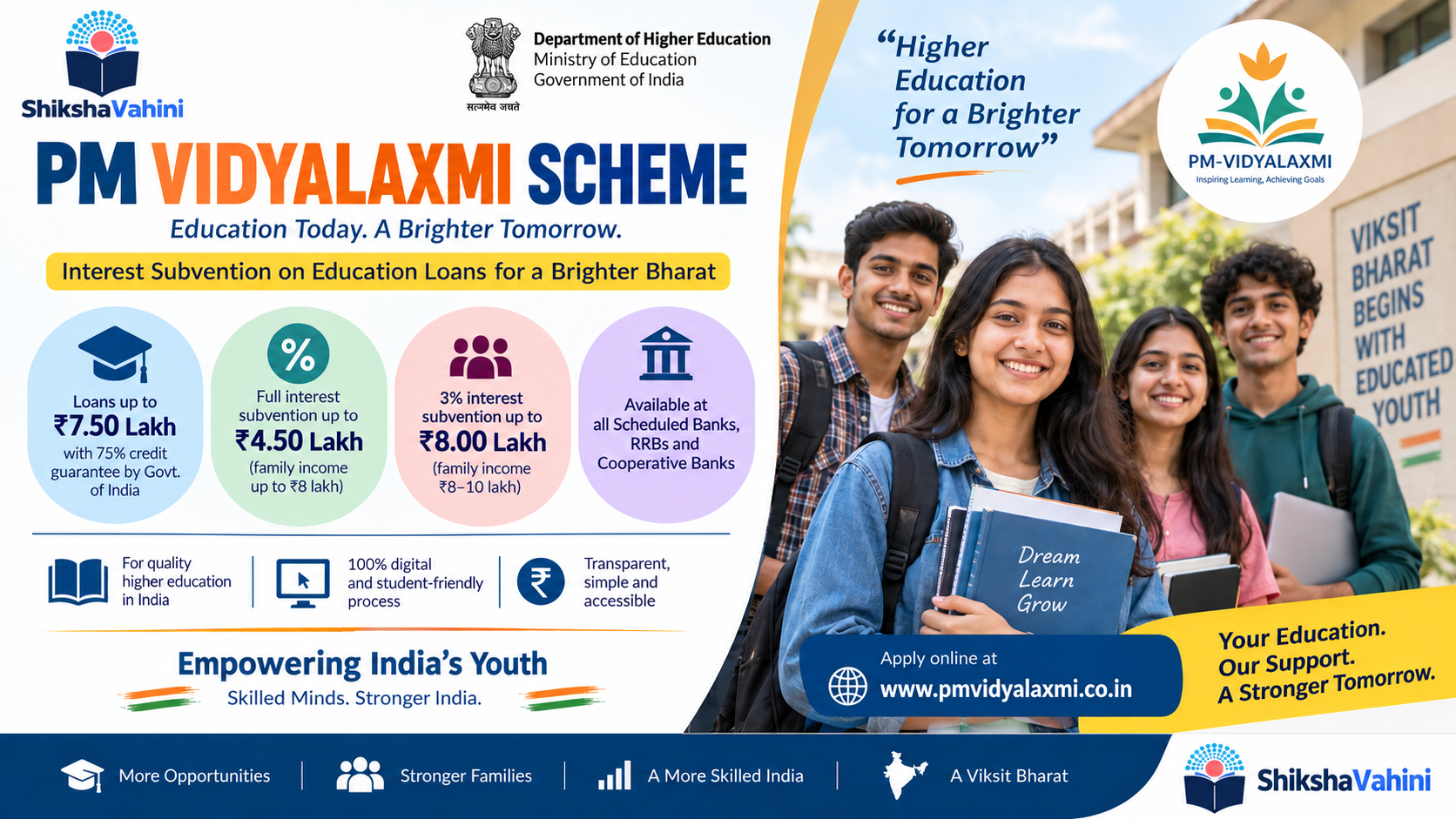
The PM Vidyalaxmi Scheme is designed to make higher education more accessible by offering collateral-free and guarantor-free education loans to meritorious students admitted to designated Quality Higher Education Institutions (QHEIs).
PM Vidyalaxmi Scheme 2026: What Students Need to Know Before Taking an Education Loan
For many Indian students, getting admission to a good college is only half the battle. The harder question often comes next:
How will the family pay for it?
Tuition fees have risen sharply across professional, technical and other higher-education programmes. Education loans can bridge that gap, but collateral requirements, guarantor requirements and interest costs can make borrowing difficult for families.
The Government of India's PM Vidyalaxmi Scheme attempts to address that problem by combining a special education-loan product with interest support for eligible students.
Under the scheme, students admitted on merit to designated Quality Higher Education Institutions can obtain collateral-free and guarantor-free education loans. The loan itself does not have a prescribed upper ceiling; the amount depends on the course fee and eligible associated expenses. For eligible students with annual family income up to ₹8 lakh, the Government provides 3% interest subvention on education loans up to ₹10 lakh during the moratorium period, subject to the scheme's annual beneficiary selection and other conditions.
Let's break down exactly how it works.
What Is the PM Vidyalaxmi Scheme?
PM Vidyalaxmi, formally known as Pradhan Mantri Vidyalaxmi, is a Central Sector Scheme approved by the Union Cabinet on 6 November 2024.
The objective is straightforward: financial constraints should not prevent a meritorious student from pursuing higher education in a quality institution.
The scheme creates a special education-loan product that is:
- Collateral-free
- Guarantor-free
- Digital
- Student-friendly
- Available through participating banks
- Integrated through a unified PM-Vidyalaxmi portal.
The scheme applies to education loans sanctioned after 6 November 2024.
PM Vidyalaxmi Scheme Eligibility
There are two different questions that students should not confuse:
- 1Can I obtain the PM-Vidyalaxmi education loan?
- 2Can I receive the 3% interest subvention?
The eligibility rules are different.
Eligibility for the Education Loan
Students can seek the special PM-Vidyalaxmi education loan if they:
- obtain admission on their own merit;
- are admitted to a designated Quality Higher Education Institution;
- are pursuing an eligible degree or diploma programme in India; and
- apply through the prescribed process.
There is no family-income ceiling for the basic PM-Vidyalaxmi education loan. Students from all family-income groups can seek the loan.
Admission through management quota or similar quota is not eligible.
That distinction is particularly important. Merely studying at a qualifying institution does not automatically make every admission route eligible.
Who Can Get the 3% Interest Subsidy?
This is where the income limit comes in.
A student whose annual family income is up to ₹8 lakh can be eligible for 3% interest subvention on an education loan up to ₹10 lakh, during the moratorium period.
If the education loan exceeds ₹10 lakh, the 3% subvention applies only to the eligible portion up to ₹10 lakh.
There is another important limitation: the Government's 3% interest-subvention benefit is targeted at up to one lakh fresh beneficiaries in a year. If eligible applications exceed the available slots, the prescribed sequential selection mechanism is used.
How Much Education Loan Can You Get Under PM Vidyalaxmi?
This is one of the most misunderstood aspects of the scheme.
There is no fixed ₹7.5 lakh or ₹10 lakh ceiling on the education loan itself.
The formal guidelines specifically state that there is no cut-off on the highest amount of education loan.
The loan amount depends on:
- tuition/course fees;
- hostel expenses;
- mess expenses;
- other refundable and non-refundable institutional fees;
- reasonable laptop cost; and
- reasonable living expenses during the course.
Therefore, a student at an expensive QHEI could potentially require a loan substantially above ₹10 lakh.
The official guidelines even give an illustrative example in which a student could obtain a ₹30 lakh collateral-free and guarantor-free loan, based on a ₹25 lakh course fee plus associated expenses.
So remember:
₹10 lakh is the interest-subvention ceiling — not the overall PM-Vidyalaxmi education-loan ceiling.
What Is the 75% Credit Guarantee?
For an education-loan sanction amount of up to ₹7.5 lakh, the Government provides a 75% credit guarantee on outstanding default, subject to the applicable credit-guarantee framework.
This guarantee is intended primarily to encourage banks to expand education-loan coverage. It is not the same thing as the Government paying 75% of the student's loan.
That distinction is crucial.
75% credit guarantee ≠ 75% loan subsidy.
The borrower remains responsible for repaying the education loan.
What Is the PM Vidyalaxmi Interest Rate?
The scheme places a cap on the interest rate charged by the lending bank.
The interest rate is capped at:
Bank's Externally Benchmarked Lending Rate (EBLR) + 0.5%
Banks may offer an interest rate lower than this cap according to their own policies.
The guidelines also state that the PM-Vidyalaxmi loan rate should be lower than the bank's education-loan rate for loans outside the scheme.
There is also provision for a lending bank to provide up to an additional 1% interest concession where interest is serviced, partially or fully, during the study and subsequent moratorium period, subject to the applicable loan terms.
How Does the 3% Interest Subvention Work?
The 3% benefit applies during the moratorium period.
The scheme defines the moratorium period as:
Course period + one year
During this period, interest is calculated at the simple annual rate on the outstanding principal/disbursed loan amount.
For eligible students, the Government bears interest corresponding to 3%, subject to the scheme conditions and the applicable amount. The student remains responsible for the balance interest and ultimately the principal.
Example
Suppose an eligible student has ₹10 lakh outstanding during a particular year and the bank's applicable interest rate is 8.5%.
Annual interest = ₹85,000.
The 3% Government subvention on ₹10 lakh would correspond to ₹30,000 for that year.
The student would therefore bear the remaining ₹55,000, subject to the exact loan balance, disbursement and scheme calculations.
The Government's own guidelines provide a detailed illustration involving a ₹30 lakh loan and show that the 3% support is calculated only on the eligible ₹10 lakh portion.
What Happens After the Moratorium?
This is another point students often misunderstand.
PM Vidyalaxmi does not mean the Government pays the interest throughout the entire repayment period.
The Government's interest support is limited to the eligible interest during the moratorium period.
After the moratorium ends, the student is responsible for repayment of the principal and interest according to the education-loan agreement with the bank.
The repayment period can extend up to 15 years after the moratorium period, consistent with the applicable IBA Model Education Loan Scheme framework.
Which Colleges and Universities Are Covered?
This is probably the most important eligibility test.
PM Vidyalaxmi is not available for every college in India.
The Quality Higher Education Institution framework covers:
1. Top 100 NIRF-ranked institutions
Institutions appearing in the top 100 of the latest NIRF rankings in overall, category-specific and/or domain-specific rankings.
2. Top 200 State/UT Government HEIs
State/Union Territory government institutions appearing within the relevant top-200 NIRF rankings.
3. Remaining Central Government HEIs
Other higher education institutions governed by the Government of India.
Foreign educational institutions and foreign campuses specified in the guidelines are not covered. The list is updated using the latest NIRF rankings.
How Many Institutions Are Covered?
This figure needs careful handling because the list is updated.
The original 2024–25 guidelines identified 860 QHEIs.
The supplied Shikshavahini brochure displays 1,049 QHEIs, reflecting a later list/update.
However, the latest Government of India update available at the time of preparing this article states that 1,425 QHEIs are currently covered.
Therefore, students should not rely on an old static number. They should check the institution's current status on the PM-Vidyalaxmi portal.
Which Courses Are Eligible?
The scheme covers graduation, post-graduation degree and diploma courses offered by eligible QHEIs.
In other words, PM-Vidyalaxmi is broader than a scheme restricted only to engineering or medicine.
This is one of the major differences between PM-Vidyalaxmi and PM-USP CSIS.
PM Vidyalaxmi vs PM-USP CSIS
This distinction deserves special attention because the two schemes are frequently confused.
| Feature | PM-Vidyalaxmi | PM-USP CSIS |
|---|---|---|
| Institution | Designated QHEIs | Approved institutions under CSIS |
| Courses | All eligible degree/diploma courses in QHEIs | Technical/professional courses |
| Family income for subsidy | Up to ₹8 lakh | Up to ₹4.5 lakh |
| Interest support | 3% during moratorium | Full interest during moratorium |
| Eligible loan for subsidy | Up to ₹10 lakh | Up to ₹10 lakh |
| Basic loan | Collateral/guarantor-free under PM-Vidyalaxmi | Subject to CSIS/loan framework |
| Annual subsidy slots | Up to 1 lakh fresh PM-Vidyalaxmi beneficiaries | No equivalent PM-Vidyalaxmi one-lakh cap |
| Main purpose | Wider access to quality HEIs | Interest support for eligible technical/professional education |
The Government explicitly describes PM-Vidyalaxmi as supplementing PM-USP CSIS. For example, a student with family income up to ₹4.5 lakh pursuing an eligible technical/professional programme may fall under full interest subvention through PM-USP CSIS, while PM-Vidyalaxmi provides 3% support for eligible students/courses under its own framework.
Can You Take PM Vidyalaxmi and Another Government Scholarship?
Generally, no double benefit is permitted for the same period/course where the student is receiving another Government scholarship, interest-subvention or fee-reimbursement benefit covered by the de-duplication rules.
Aadhaar-based de-duplication is undertaken through PFMS for applicable Government schemes.
If a student is identified as receiving another applicable benefit, the student may, in specified circumstances, be given an opportunity to choose between the benefits.
PM Vidyalaxmi Application Process
The application is designed to be completely digital.
Students should use the official PM-Vidyalaxmi portal:
The current portal describes the process as:
Register → Fill Common Education Loan Application Form → Select Bank → Submit → Track Application
The portal allows students to search for and apply for education loans offered by participating banks.
Step 1: Register
Create a student account using your:
- Name
- Mobile number
- Email ID
- Password
The portal uses the registered email/mobile for communications and notifications.
Step 2: Fill the Common Application Form
Enter personal, academic and course-related information.
The scheme was designed around a simple two-page common education-loan application format.
Step 3: Upload the Required Information/Documents
Submit the applicable academic, identity, admission and other documents.
Step 4: Select the Bank
The current portal allows students to choose participating banks according to their requirements and eligibility.
Step 5: Submit the Application
The application is routed to the selected bank(s) for processing.
Step 6: Track the Loan
Students can monitor:
- application status;
- bank responses;
- document requirements;
- sanction;
- disbursement; and
- other pending actions through the portal.
Documents Required for PM Vidyalaxmi
The exact documents requested by the lending bank can vary, but the scheme guidelines identify the following basic documents for interest-subvention processing:
- Aadhaar
- PAN
- Address proof
- Previous qualifying examination mark sheets
- Entrance examination result
- Institution offer/admission letter
- Fee structure
- Income certificate/proof issued or verified by the designated public authority.
The supplied Shikshavahini brochure additionally highlights Aadhaar, passport-size photographs, Class X/XII or graduation marksheets, admission/offer letter with expense schedule and income certificate where interest subvention is being claimed.
An important procedural point: the income certificate is not required to be uploaded at the initial education-loan application stage merely because the student has declared income. Eligible students are subsequently informed to complete the interest-subvention process and provide the required proof.
Is There a PM Vidyalaxmi Last Date?
There is no single universal "PM Vidyalaxmi last date" for every applicant.
This is an important SEO query because many students search for "PM Vidyalaxmi last date" expecting one annual deadline.
The scheme guidelines instead provide stage-specific deadlines.
For interest subvention, eligible students are notified to apply within the stipulated period. If they do not apply within that period, they may lose the interest-subvention benefit for that year. Students are specifically advised to check the portal periodically for applicable cut-off dates.
There are also specific deadlines after the interest-subvention amount reaches the digital wallet.
Under the formal guidelines, if the student does not exercise the redemption option within three months of the credit, the amount is returned to the Department of Higher Education and the student loses that year's interest-subvention benefit.
Therefore, students should not rely on a generic "last date" circulating on social media. Check the PM-Vidyalaxmi portal for the deadline applicable to your application and academic year.
PM Vidyalaxmi Digital Rupee Wallet and Interest Subsidy
The interest-subvention system uses an e-voucher/Programmable CBDC wallet.
Once the interest-subvention claim is approved, the student is notified to install/use the digital wallet. The approved amount is credited to the wallet and can then be redeemed towards the student's education-loan account through the prescribed process.
The supplied brochure also highlights this digital-wallet mechanism and instructs students to use the PM-Vidyalaxmi Digital Rupee application on their Aadhaar-linked mobile number.
What Happens If the Student Leaves the Course?
Interest-subvention and credit-guarantee benefits are generally not available if the student discontinues the course midway or is expelled on disciplinary or academic grounds.
An exception exists where discontinuation is due to medical grounds, subject to the required documentation and satisfaction of the head of the educational institution.
How Many Times Can the Benefit Be Used?
The interest-subvention and credit-guarantee benefits under PM-Vidyalaxmi are available only once, for either:
- undergraduate;
- postgraduate; or
- integrated course.
The scheme therefore should not be treated as a benefit that can be repeatedly claimed for multiple levels of education.
Why PM Vidyalaxmi Matters
The most significant feature of PM-Vidyalaxmi is not simply the 3% interest subsidy.
It is the combination of:
merit-based admission + quality institution + collateral-free loan + guarantor-free loan + digital processing + targeted interest support.
For a student admitted to an expensive institution, removing the collateral/guarantor barrier can be more valuable than a modest reduction in the interest burden.
And for lower-income families, the 3% interest subvention can reduce the cost of borrowing during the period when the student is still studying and has not yet entered full repayment.
PM Vidyalaxmi Scheme: Key Points at a Glance
- Scheme: Pradhan Mantri Vidyalaxmi
- Approved: 6 November 2024
- Loan: Collateral-free and guarantor-free for eligible QHEI admissions
- Income limit for basic loan: No income ceiling
- 3% interest subvention: Family income up to ₹8 lakh
- Subvention loan limit: Up to ₹10 lakh
- Credit guarantee: 75% for loans up to ₹7.5 lakh, subject to applicable rules
- Interest-rate cap: EBLR + 0.5%
- Eligible courses: Graduation, post-graduation and diploma courses in eligible QHEIs
- Repayment: Up to 15 years after moratorium
- Moratorium: Course period + one year
- Application: Online through PM-Vidyalaxmi portal
- Management quota: Not eligible
- Current QHEI coverage: 1,425 according to the latest July 2026 Government update.
Frequently Asked Questions About PM Vidyalaxmi
Is PM Vidyalaxmi loan completely interest-free?
No. The education loan is not generally interest-free. Eligible students with annual family income up to ₹8 lakh can receive 3% interest subvention during the moratorium period on the eligible loan amount up to ₹10 lakh.
What is the maximum PM Vidyalaxmi loan amount?
There is no prescribed upper ceiling on the education loan itself. The amount depends on eligible course fees and associated expenses. However, the interest-subvention benefit is limited to an eligible loan amount of ₹10 lakh.
Is PM Vidyalaxmi available to all students?
Not automatically. The student must obtain eligible merit-based admission to a designated Quality Higher Education Institution. Management-quota admissions are excluded.
What is the PM Vidyalaxmi income limit?
There is no family-income ceiling for the basic education loan. The ₹8 lakh annual family-income ceiling applies to the 3% interest-subvention benefit.
Can students from private colleges apply?
Yes, provided the institution qualifies as a designated QHEI under the applicable criteria. The scheme is not restricted to government institutions.
Does PM Vidyalaxmi cover diploma courses?
Yes. Eligible graduation, post-graduation degree and diploma courses offered by QHEIs are covered.
Does PM Vidyalaxmi cover management-quota admission?
No. Management-quota or similar-quota admissions are specifically excluded.
What is the PM Vidyalaxmi official website?
The official unified portal is:
Students can register, apply for education loans, track applications and claim interest subvention where eligible.
Is Aadhaar mandatory?
The current PM-Vidyalaxmi portal states that Aadhaar is mandatory for benefits under the PM-Vidyalaxmi Scheme, including education loans, interest subvention and credit-guarantee coverage.
Is there one fixed PM Vidyalaxmi last date?
No single universal last date applies to every stage. Interest-subvention applicants must follow the stipulated deadlines communicated through the portal. Students should regularly check their portal account for applicable cut-off dates.
Can PM Vidyalaxmi be combined with another Government interest subsidy?
Generally, the same student cannot simultaneously receive another applicable Government scholarship or interest-subvention benefit for the same period/course. De-duplication is carried out under the scheme's rules.
Final Word: Check Eligibility Before Assuming You Qualify
PM Vidyalaxmi is potentially a significant improvement over a conventional education loan for a student who has earned admission to a qualifying institution but cannot offer collateral or a third-party guarantee.
But it is important not to reduce the scheme to the headline "3% interest subsidy."
The real benefit depends on four things:
your institution, your admission route, your family income and your loan structure.
Most importantly, verify that your institution is currently listed as a QHEI and use the official portal rather than relying on an old college brochure, WhatsApp message or outdated list.
FAQs
Preliminary assessment only. Final eligibility, interest rate and loan terms are determined by the lender.