
Education Loans
How Much Education Loan Can I Get for Studying Abroad?
ShikshaVahini Team · 11 October 2026 · 6 min read
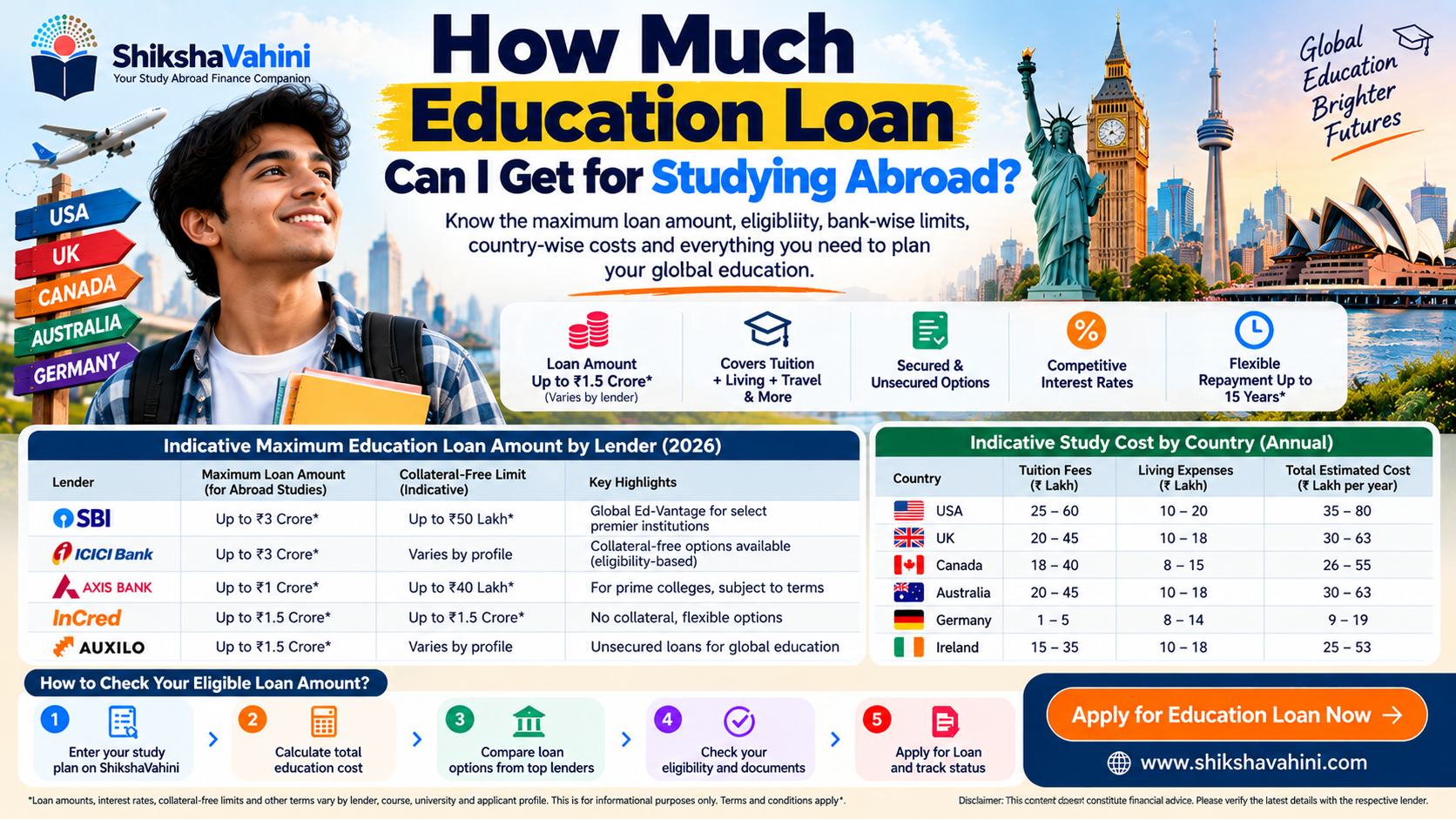
Planning to study abroad is exciting—until you start adding tuition fees, accommodation, flights, insurance, visa costs and everyday expenses. Suddenly, a ₹25 lakh plan can become ₹40 lakh, and a ₹40 lakh plan can become ₹70 lakh.
How Much Education Loan Can I Get for Studying Abroad?
Planning to study abroad is exciting—until you start adding tuition fees, accommodation, flights, insurance, visa costs and everyday expenses. Suddenly, a ₹25 lakh plan can become ₹40 lakh, and a ₹40 lakh plan can become ₹70 lakh.
That is where one of the most important questions for an Indian student comes in:
“How much education loan can I get for studying abroad?”
The answer is not simply a fixed amount offered by every bank. Your eligible education loan amount depends on the university, course, country, total cost of attendance, academic profile, co-applicant, credit history, repayment capacity, collateral and the lender's internal policies.
In 2026, some lenders advertise overseas education loans of ₹1 crore, ₹1.5 crore or even ₹3 crore, while collateral-free limits can be substantially lower—or available only for selected universities and profiles. For example, SBI's Global Ed-Vantage scheme currently provides loans above ₹7.50 lakh up to ₹3 crore, with collateral-free loans up to ₹50 lakh for select premier institutions. SBI Bank
So the better question isn't just “What is the maximum education loan?”
It is:
“How much education loan can I realistically get for MY study-abroad plan?”
Let's calculate that properly.
How Much Education Loan Can I Get for Studying Abroad?
Depending on the lender and your profile, an education loan for overseas studies can range from a few lakh rupees to ₹1 crore, ₹1.5 crore or ₹3 crore or more.
However, the maximum advertised loan amount should never be confused with your eligible loan amount.
For example:
Suppose your two-year master's programme has:
- Tuition fees: ₹38 lakh
- Living expenses: ₹16 lakh
- Travel and visa: ₹3 lakh
- Insurance: ₹2 lakh
- Laptop/books/other expenses: ₹2 lakh
Your estimated total cost is:
₹61 lakh
If you have:
- Scholarship: ₹5 lakh
- Family contribution: ₹6 lakh
Your approximate funding requirement becomes:
₹61 lakh − ₹5 lakh − ₹6 lakh = ₹50 lakh
Your required loan may therefore be around ₹50 lakh, subject to the lender's margin, eligible expenses and credit assessment.
This is very different from simply asking a bank for “₹1 crore.”
The Basic Formula to Calculate Your Education Loan Requirement
A useful starting formula is:
Education Loan Requirement = Total Eligible Education Cost − Scholarship − Own Contribution
Your total education cost may include:
Tuition + accommodation + food/living expenses + travel + visa + insurance + books + laptop/equipment + examination fees + other eligible expenses
But remember: every lender has its own rules about which expenses can be financed and how much of each expense can be considered.
For example, SBI's Global Ed-Vantage scheme lists tuition, hostel, examination/library/laboratory fees, travel, books, equipment, computer and certain other course-related expenses among eligible costs, subject to its scheme conditions. SBI Bank
Infographic: How Your Education Loan Amount Is Calculated
🎓 YOUR STUDY-ABROAD FUNDING FORMULA
Tuition Fees ↓ + Living & Accommodation ↓ + Travel, Visa & Insurance ↓ + Books / Laptop / Other Eligible Costs ↓
= Total Study Cost
↓ − Scholarship / Assistantship ↓ − Family Contribution / Margin ↓
= Approximate Education Loan Requirement
Important: The final sanctioned amount depends on lender eligibility, course/university, co-applicant profile, credit assessment, margin requirements and applicable terms.
What Is the Maximum Education Loan for Abroad Studies?
There is no single maximum amount applicable to every student.
Different lenders have different loan limits.
Here is an indicative comparison based on currently published lender information:
| Lender | Indicative Maximum for Abroad Studies | Collateral-Free / Unsecured Availability |
|---|---|---|
| SBI Global Ed-Vantage | Up to ₹3 crore | Up to ₹50 lakh for select premier institutions |
| ICICI Bank | Up to ₹3 crore | Available based on course, institution and eligibility |
| Axis Bank | Up to ₹1 crore under Prime Abroad | Unsecured options subject to product/profile |
| HDFC Bank/Credila | Full cost with collateral; unsecured options available | Up to ₹75 lakh under published foreign education loan information |
| InCred | Based on certified cost of attendance and eligibility | Collateral-free options available |
| Bank of Baroda | Up to ₹1.50 crore for specified premier institutions | Its Baroda Scholar abroad scheme requires security above specified thresholds |
SBI currently publishes a maximum of ₹3 crore under Global Ed-Vantage, with collateral-free financing up to ₹50 lakh for select premier institutions. SBI Bank
ICICI Bank currently states that its instant education loan can go up to ₹3 crore for international and domestic studies, with collateral-free availability depending on the course, institution and applicant eligibility. ICICI Bank
Axis Bank currently advertises its Prime Abroad product with unsecured loans up to ₹1 crore, while its income-based funding product offers unsecured loans up to ₹50 lakh, subject to applicable conditions. AxisBank
HDFC Bank's published foreign education loan information states that full education costs can be covered where collateral is provided and unsecured loans are available up to ₹75 lakh, with tenure up to 14 years including moratorium. HDFC Bank
Bank of Baroda's Baroda Scholar scheme states a maximum of ₹150 lakh for specified premier institutions and ₹60 lakh for institutions outside its premier list. It also explicitly states that its Baroda Scholar scheme does not offer abroad education loans without collateral. Bank of Baroda
*Terms and conditions apply. Loan limits are indicative and can change according to lender policy, applicant profile, university, course and other eligibility conditions.**
Why Two Students Can Get Different Loan Amounts
This is one of the biggest misconceptions about education loans.
Two students may have admission to the same country but receive different loan offers.
Why?
Because lenders don't look only at the university fee.
They evaluate the complete risk profile.
1. University and Course
The reputation of the university and employability of the programme can significantly influence underwriting.
A student admitted to a highly ranked university with a strong employment history for graduates may receive a more favourable assessment than someone applying to a lesser-known institution.
2. Total Cost of Education
A ₹30 lakh requirement is obviously different from a ₹90 lakh requirement.
The lender evaluates:
- Tuition
- Accommodation
- Living expenses
- Travel
- Insurance
- Other eligible expenses
- Course duration
3. Academic Profile
Your:
- 10th/12th marks
- Graduation marks
- Entrance examination scores
- Academic consistency
- Previous qualifications
can influence the lender's assessment.
4. Co-Applicant Income
For many education loans, the parent or another eligible person acts as a co-applicant.
The lender may evaluate:
- Monthly income
- Employment stability
- Existing EMIs
- Credit history
- Banking relationship
- Income-tax returns
- Assets and liabilities
5. Credit Score
A strong co-applicant credit profile can make your application more comfortable for the lender.
A weak credit history, multiple defaults or excessive existing debt can affect eligibility.
6. Collateral
Collateral can substantially change the amount that can be financed.
A secured loan may allow a lender to consider a larger loan amount than an unsecured loan.
Secured vs Unsecured Education Loan: Which Gives You More?
Think of collateral as an additional safety net for the lender.
Secured Education Loan
You provide an acceptable asset as security.
Examples may include:
- Residential property
- Commercial property
- Fixed deposits
- Government securities
- Certain financial investments
Because the lender has security, higher loan amounts may be possible.
Unsecured Education Loan
No property or other tangible collateral is pledged.
However, that does not mean the lender ignores your financial profile.
Instead, the lender may place greater emphasis on:
University + Course + Academic Record + Co-Applicant + Income + Credit History + Future Repayment Potential
Can I Get a ₹50 Lakh Education Loan Without Collateral?
Yes, it can be possible—but it is not automatically available to every student.
SBI's Global Ed-Vantage scheme, for example, currently provides collateral-free loans up to ₹50 lakh for students admitted to select premier institutions. SBI Bank
ICICI Bank also states that collateral-free education loans for overseas studies can be available up to ₹3 crore, subject to course, institution and eligibility conditions. ICICI Bank
Specialist lenders can also offer unsecured education loans based on the student's university, programme, academic record and repayment potential.
InCred, for example, states that its maximum loan can be based on the entire certified cost of attendance, subject to its loan parameters, while its interest pricing considers factors such as academic performance, future repayment potential, credit history and securities provided. InCred Financial Services
So don't assume:
₹50 lakh required = ₹50 lakh unsecured loan automatically approved.
The student's profile matters.
How Much Education Loan Can I Get Without Collateral?
A useful way to think about unsecured education loans is:
Higher-quality profile → potentially higher eligible unsecured amount
Your profile becomes stronger when you have:
✅ Good academic performance ✅ Recognised university ✅ Employable course ✅ Strong admission credentials ✅ Stable co-applicant income ✅ Good credit history ✅ Low existing debt ✅ Reasonable total education cost ✅ Strong future earning potential
There is no universal formula that guarantees a particular amount.
How Much Education Loan Can I Get for USA?
The USA is one of the most expensive destinations for Indian students.
A master's programme can involve:
- Tuition fees
- Housing
- Food
- Health insurance
- Travel
- Visa expenses
- University fees
- Books and technology
- Personal expenses
Therefore, a US education loan requirement can easily reach ₹40 lakh–₹80 lakh or more, depending on the university, programme and location.
For example:
Example — USA Master's
Tuition: ₹45 lakh Living expenses: ₹18 lakh Travel/insurance/other: ₹5 lakh
Total = ₹68 lakh
Suppose:
Scholarship = ₹8 lakh Family contribution = ₹10 lakh
Then:
Estimated loan requirement = ₹50 lakh
The student could explore both secured and unsecured options depending on the university and profile.
How Much Education Loan Can I Get for UK?
The UK can sometimes have a shorter programme duration than other destinations, which can affect the overall cost.
Suppose your programme costs:
Tuition: ₹30 lakh Living expenses: ₹14 lakh Other costs: ₹4 lakh
Total:
₹48 lakh
With ₹8 lakh from family savings and ₹5 lakh scholarship:
Loan requirement = ₹35 lakh
The important lesson is that course duration matters as much as tuition fees.
A higher annual tuition fee does not automatically mean a higher total cost if the programme is shorter.
How Much Education Loan Can I Get for Canada?
Canada remains an important destination for Indian students, although the total financial requirement varies significantly by programme and location.
Suppose:
Tuition: ₹28 lakh Living expenses: ₹14 lakh Other costs: ₹4 lakh
Total:
₹46 lakh
After:
Scholarship = ₹4 lakh Family contribution = ₹7 lakh
Required loan:
₹35 lakh
The lender will then determine the final eligible amount based on its underwriting criteria.
How Much Education Loan Can I Get for Australia?
Suppose your total cost is:
- Tuition: ₹32 lakh
- Accommodation/living: ₹15 lakh
- Travel/insurance/other: ₹4 lakh
Total = ₹51 lakh
If your family contributes ₹8 lakh and you receive a ₹3 lakh scholarship:
Estimated loan requirement = ₹40 lakh
Again, this is a planning example, not a guaranteed loan sanction.
How Much Education Loan Can I Get for Germany?
Germany can be financially attractive for some students because tuition structures can differ significantly between universities and programmes.
However, don't assume:
“Low tuition = low education loan.”
You still need to budget for:
- Living expenses
- Blocked-account requirements where applicable
- Health insurance
- Travel
- Visa-related expenses
- Accommodation
- Semester contributions
- Books and other costs
Your education loan requirement should therefore be calculated from the complete funding requirement, not tuition alone.
What Expenses Can an Education Loan Cover?
Depending on the lender and scheme, education loans may cover expenses such as:
Academic Costs
- Tuition fees
- Examination fees
- Laboratory fees
- Library fees
- University charges
Living Costs
- Hostel
- Accommodation
- Food/living expenses, where eligible
Travel
- Airfare/passage expenses
- Certain travel-related costs
Study Equipment
- Laptop/computer
- Books
- Instruments
- Equipment
Other Costs
- Insurance
- Caution deposit
- Certain project/thesis expenses
- Other approved course-related expenses
For example, SBI's Global Ed-Vantage scheme specifically lists tuition, hostel, examination/library/laboratory fees, travel, books, equipment and computers among eligible expenses, subject to scheme conditions. SBI Bank
Auxilo similarly states that its study-abroad financing can cover tuition, examination fees, living expenses, travel and other course-related costs. Auxilo
Don't Make This Mistake: Loan Amount ≠ Money Received in Your Bank Account
An education loan generally isn't designed like a personal loan where the entire sanctioned amount is simply deposited into your savings account.
Disbursement may happen in stages or tranches according to university requirements.
SBI states that education-loan disbursement can be made in stages according to requirements, including payments to institutions and vendors. State Bank of India
InCred also states that student loans can be disbursed in instalments, including semester-based disbursement, with tuition payments transferred through the prescribed process. InCred Financial Services
This is why you should carefully understand the lender's sanction letter and disbursement schedule before accepting an offer.
How Much Education Loan Should You Actually Take?
This is more important than asking for the maximum.
Don't borrow ₹70 lakh simply because you are eligible for ₹70 lakh.
Borrow according to your actual funding gap.
Consider this example:
Scenario A
Total cost: ₹55 lakh Scholarship: ₹5 lakh Savings: ₹10 lakh
Required funding:
₹40 lakh
Taking ₹55 lakh simply because the lender offers it could create unnecessary interest costs.
Scenario B
Total cost: ₹55 lakh Scholarship: ₹2 lakh Savings: ₹3 lakh
Required funding:
₹50 lakh
Here, a larger loan may genuinely be necessary.
The objective should be:
Borrow enough to complete the education comfortably—but not more than necessary.
What If My Education Loan Is Not Enough?
Suppose your total cost is ₹65 lakh but your lender approves only ₹45 lakh.
You have several options.
Option 1: Increase Your Own Contribution
Use:
- Savings
- Family contribution
- Investments
- Scholarship
Option 2: Compare Another Lender
Different lenders may assess the same profile differently.
Option 3: Consider a Secured Loan
If a suitable collateral asset is available, a secured loan may support a higher funding requirement.
Option 4: Reduce the Funding Gap
Look for:
- Scholarships
- Assistantships
- University grants
- Lower-cost accommodation
- Part-time work permitted under applicable visa rules
Option 5: Reconsider the Course/University
Sometimes changing the university can reduce the overall cost by ₹10–₹20 lakh without compromising the quality of the programme.
How Lenders Decide Your Maximum Education Loan
Think of the lender's credit team as answering one question:
“If we finance this student's education, how comfortable are we that the loan can eventually be repaid?”
They may consider:
Student
- Academic history
- University
- Course
- Country
- Admission status
- Future employability
Co-Applicant
- Income
- Employment/business
- Credit score
- Existing liabilities
- Banking history
- ITRs
Loan
- Requested amount
- Margin
- Tenure
- Interest rate
- Collateral
- Repayment structure
Family
- Financial contribution
- Assets
- Existing obligations
- Overall financial stability
Documents Usually Required for an Education Loan
The exact list varies by lender, but you should generally prepare:
Student Documents
- PAN
- Aadhaar/passport
- Address proof
- Academic certificates
- Marksheets
- Entrance-test scores where applicable
- Admission/offer letter
- University fee structure
- I-20/CAS or equivalent document where applicable
- Course details
Co-Applicant Documents
- PAN
- Aadhaar/address proof
- Salary slips
- Bank statements
- Form 16
- Income-tax returns
- Employment/business proof
- Existing loan details
Collateral Documents
For secured loans, additional documents may include:
- Property title documents
- Previous sale deeds
- Encumbrance-related documents
- Tax receipts
- Approved plans
- Valuation-related documents
The lender may ask for additional documentation during underwriting.
Does a Higher Loan Amount Mean Higher EMI?
Absolutely.
Consider an illustrative example:
Loan amount: ₹50 lakh
Interest rate: 10% p.a.
Tenure: 15 years
The EMI would be approximately:
₹53,700 per month
Total repayment over 15 years would be approximately:
₹96.7 lakh
That means the interest component could be roughly:
₹46.7 lakh
This is why a ₹50 lakh education loan should not be viewed as simply “₹50 lakh funding.”
It is a long-term financial commitment.
This example is for illustration only. Actual EMI depends on the sanctioned rate, tenure, disbursement schedule, moratorium treatment and lender terms.
What Happens to Interest During the Moratorium?
This is another point students often overlook.
An education loan generally provides a repayment holiday covering the study period plus an additional period specified by the lender.
But:
Moratorium does not necessarily mean interest-free.
Interest may continue to accrue during the study and moratorium period.
SBI's Global Ed-Vantage scheme states that simple interest is charged during the course and moratorium period and that accrued interest can be added to principal if it is not serviced during this period. SBI Bank
Therefore, if financially possible, servicing interest during the study period can reduce the amount that ultimately gets converted into the repayment burden.
Can Education Loan Interest Give You a Tax Benefit?
Potentially, yes.
Under Section 80E of the Income Tax Act, eligible taxpayers can claim a deduction for interest paid on a qualifying education loan for higher education of self or a relative, subject to applicable conditions.
The Income Tax Department requires details such as the lender, loan account number, sanction date, total loan and outstanding balance for the relevant ITR disclosure. Income Tax Department
Tax rules and applicability can change, so check the latest income-tax rules and your individual tax situation before relying on a tax benefit.
What About PM-Vidyalaxmi?
Students sometimes confuse PM-Vidyalaxmi with an overseas education-loan scheme.
PM-Vidyalaxmi is designed around eligible quality higher education institutions in India. The Ministry's guidelines illustrate collateral-free and guarantor-free loans for eligible students studying at qualifying institutions in India. Education.gov.in
Therefore, if your goal is a master's degree in the USA, UK, Canada, Australia or another foreign destination, you should separately evaluate overseas education loan products offered by banks and education-finance institutions.
7 Steps to Find Your Right Education Loan Amount
STEP 1 — Get Your Complete Cost
Don't calculate only tuition.
Add:
Tuition + living + accommodation + travel + insurance + visa + books + laptop + other eligible expenses
STEP 2 — Deduct Scholarships
Subtract confirmed scholarships, grants and assistantships.
STEP 3 — Calculate Family Contribution
Determine how much your family can realistically contribute without destroying its emergency fund or long-term savings.
STEP 4 — Calculate the Funding Gap
That is your preliminary loan requirement.
STEP 5 — Compare Lenders
Don't compare only interest rates.
Compare:
- Maximum loan
- Collateral requirement
- Margin
- Processing fee
- Moratorium
- Repayment period
- Prepayment conditions
- Insurance
- Disbursement process
- Forex/payment process
STEP 6 — Check Eligibility
Understand whether your university, course and co-applicant meet the lender's requirements.
STEP 7 — Apply
Once you have identified the most suitable funding structure, submit your documents and application.
The Smartest Way to Calculate Your Education Loan
Instead of asking:
“Which bank will give me the maximum loan?”
Ask these five questions:
1. What is my total cost?
2. How much can I fund myself?
3. How much scholarship do I have?
4. How much loan do I actually need?
5. What EMI can I realistically afford after graduation?
That final question is critical.
A ₹70 lakh loan may be technically possible, but if your expected post-study income makes the EMI uncomfortable, the loan may not be financially sensible.
Education Loan Planning Example
Let's put everything together.
Student Profile
Course: Master's Country: USA Duration: 2 years
Estimated Costs
| Expense | Amount |
|---|---|
| Tuition | ₹42 lakh |
| Living & accommodation | ₹18 lakh |
| Travel & visa | ₹3 lakh |
| Insurance | ₹2 lakh |
| Books/laptop/other | ₹2 lakh |
| Total | ₹67 lakh |
Funding Sources
| Source | Amount |
|---|---|
| Scholarship | ₹7 lakh |
| Family contribution | ₹10 lakh |
| Required education loan | ₹50 lakh |
So the student should ideally compare lenders for approximately ₹50 lakh, rather than blindly applying for the maximum possible loan.
How ShikshaVahini Can Help
Calculating an education loan manually can become complicated very quickly.
You need to consider:
University + country + tuition + living expenses + scholarship + savings + loan amount + interest rate + repayment period + EMI
This is exactly why ShikshaVahini is designed to help students approach education financing more systematically.
Instead of beginning with:
“Which bank should I apply to?”
begin with:
“How much do I actually need to borrow?”
Then compare suitable education-loan options.
👉 Ready to calculate your education loan requirement?
Visit [ShikshaVahini](https://shikshavahini.com?utm_source=shikshavahini.com) and click “Apply for Loan” to take the next step.
Frequently Asked Questions About Education Loans for Studying Abroad
1. How much education loan can I get for studying abroad?
It depends on the lender, university, course, total cost, academic profile, co-applicant, income, credit history and collateral. Depending on the lender and profile, overseas education loans can range from several lakh rupees to ₹1 crore, ₹1.5 crore or ₹3 crore or more.
2. Can I get a ₹50 lakh education loan?
Yes. A ₹50 lakh education loan is possible for eligible students, subject to lender policies and underwriting. Both secured and unsecured options may be available depending on the university and applicant profile.
3. Can I get ₹50 lakh without collateral?
Yes, it can be possible for eligible students. SBI, for example, currently provides collateral-free loans up to ₹50 lakh for select premier institutions under Global Ed-Vantage. SBI Bank
4. Can I get a ₹1 crore education loan without collateral?
It can be possible with some lenders and for qualifying profiles, courses and institutions. However, ₹1 crore unsecured financing should never be treated as automatically available to every student.
5. Can I get a ₹3 crore education loan for studying abroad?
Yes, some lenders currently publish overseas education-loan limits up to ₹3 crore. SBI Global Ed-Vantage and ICICI Bank currently publish ₹3 crore maximums, subject to their respective eligibility and terms. SBI Bank
6. Can I get an education loan without property?
Yes. These are generally called unsecured education loans or collateral-free education loans. Eligibility depends on the lender and your profile.
7. Does education loan cover living expenses abroad?
Many education-loan products can cover eligible living, accommodation and other study-related expenses. The exact amount and treatment vary by lender.
8. Does scholarship reduce the education loan amount?
Usually, scholarships or assistantships are considered when calculating the student's funding requirement and/or margin. SBI, for example, states that scholarship/assistantship is included in margin under Global Ed-Vantage. SBI Bank
9. Can I get an education loan without a co-applicant?
It depends on the lender and product. Many Indian education-loan structures involve a parent, guardian or other eligible co-applicant, particularly for large loans.
10. Does my CIBIL score matter for an education loan?
Yes, the credit profile of the co-applicant/borrower can influence underwriting. A strong credit history can improve the overall strength of the application.
11. Can I get an education loan if my parents have low income?
Possibly, depending on the university, course, collateral, credit profile and lender. Specialist education-finance providers may assess several factors beyond salary income.
12. Can education loan cover the entire cost of studying abroad?
Some lenders may finance a very high percentage or even the entire eligible cost subject to their rules, while others require a margin or contribution from the borrower. InCred, for example, states that its loan can cover the entire certified cost of attendance if the application meets its parameters. InCred Financial Services
13. Is secured education loan better than unsecured education loan?
Neither is universally better.
A secured loan can potentially provide a higher amount and/or pricing advantage, while an unsecured loan avoids pledging property.
The right choice depends on your funding requirement and family finances.
14. How long is the education loan repayment period?
Many overseas education-loan products provide long repayment periods. SBI Global Ed-Vantage allows repayment up to 15 years after course and moratorium, while ICICI and Axis also publish repayment periods extending up to 15 years for applicable products. SBI Bank
15. When does education-loan repayment start?
It generally starts after the applicable study/moratorium period. The exact structure varies by lender and product.
16. Is interest charged during the study period?
Usually, yes. An education-loan moratorium generally postpones principal repayment; it does not necessarily mean that interest stops accumulating.
17. Can I repay my education loan early?
Many lenders permit prepayment or foreclosure subject to their applicable terms. Always check the sanction letter and current charges before making a decision.
18. Which is the best bank for an education loan abroad?
There is no single best bank for every student.
The best lender is the one that offers a suitable combination of:
Loan amount + interest rate + collateral requirement + margin + university acceptance + processing time + repayment flexibility + total cost.
Final Takeaway
The maximum education loan you can get is not necessarily the education loan you should take.
Your ideal loan should be based on a simple calculation:
Total Study Cost
− Scholarship − Affordable Family Contribution
= Required Education Loan
Then ask whether the resulting EMI is compatible with your expected post-study income.
That's the difference between simply getting an education loan and financing your international education responsibly.
If you're planning to study abroad and want to understand your likely loan requirement, eligibility and available options, visit ShikshaVahini – Study Abroad Finance and click “Apply for Loan.”
⚠️ Disclaimer
Disclaimer: This article is for general educational and informational purposes only and should not be considered financial, tax, legal or investment advice. Loan amounts, interest rates, eligibility criteria, collateral requirements, margins, processing fees, repayment periods and other terms are subject to change and may vary by lender, course, university, country and applicant/co-applicant profile. Final loan sanction and disbursement are solely at the discretion of the respective lender after its underwriting, verification and documentation process. Students should verify the latest terms directly with the respective lender before making financial decisions.
*Terms & Conditions Apply*
FAQs
Preliminary assessment only. Final eligibility, interest rate and loan terms are determined by the lender.