
Education Loans
Education Loan Without Collateral for Study Abroad 2026: Complete Guide for Indian Students
ShikshaVahini Team · 4 October 2026 · 6 min read
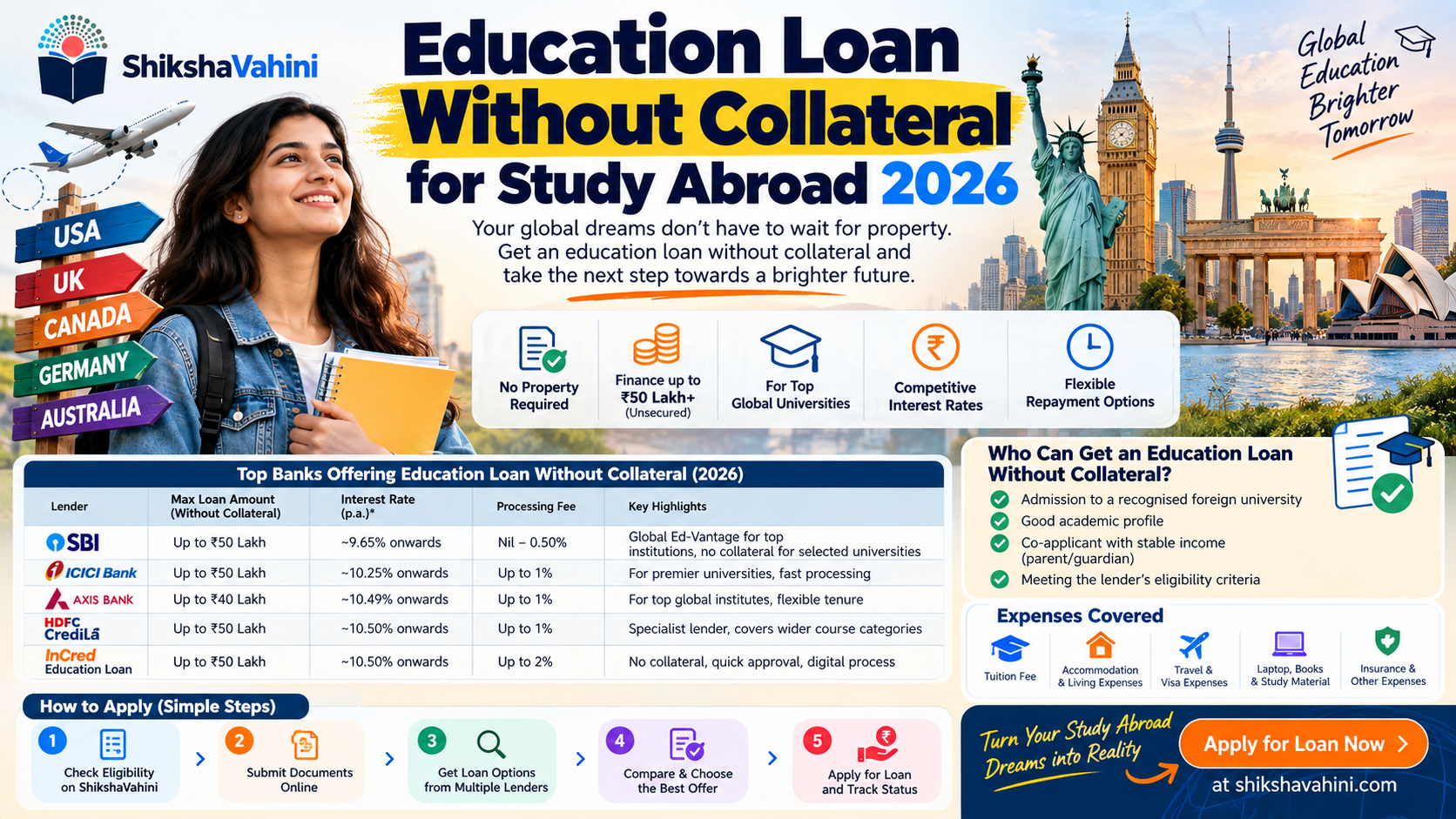
No Property? No Problem! 🎓 Discover how Indian students can get education loans without collateral for studying abroad in 2026.
Education Loan Without Collateral for Study Abroad 2026: Complete Guide for Indian Students
You have the admission letter. You have the university dream. You may even have the visa plan. But there is one problem: your family does not have a house, land or fixed deposit that you want to pledge.
Does that mean your study-abroad dream has to stop?
No.
In 2026, Indian students can access collateral-free, non-collateral or unsecured education loans for eligible overseas programmes. But there is an important catch: “without collateral” does not mean “without eligibility.”
The lender may look closely at your university, course, academic profile, co-applicant, income, credit history, loan amount and future earning potential.
For example, SBI's current Global Ed-Vantage scheme provides collateral-free loans of up to ₹50 lakh for select premier foreign institutions, while ICICI Bank currently advertises collateral-free education-loan options for eligible students, with the actual amount depending on the course, institution and applicant profile. Axis Bank's published education-loan material states that unsecured funding up to ₹40 lakh may be available for prime colleges, subject to conditions. SBI Bank
So, if you're searching for “education loan without collateral for abroad studies,” “unsecured education loan,” “study abroad loan without property,” or “collateral-free education loan in India,” this guide explains exactly how it works.
What Is an Education Loan Without Collateral?
An education loan without collateral—also called a non-collateral education loan, unsecured education loan or collateral-free education loan—is a student loan where you do not pledge an asset such as:
- Residential property
- Commercial property
- Land
- Fixed deposits
- Gold
- Certain investments or securities
as security for the loan.
Instead, the lender evaluates the overall strength of the application.
Think of it this way:
Secured education loan
“Show me an asset that protects my loan.”
Unsecured education loan
“Show me why I believe this student and this education programme can support repayment.”
That second assessment is why the university and course can become extremely important.
Can I Get an Education Loan for Abroad Studies Without Collateral?
Yes—but not everyone qualifies.
This is the first thing students need to understand.
A collateral-free education loan is not automatically available simply because you don't own property.
Lenders may consider:
Student profile + university + course + co-applicant + income + credit history + loan requirement + future earning potential
For example, Axis Bank's published eligibility information for one of its unsecured overseas-loan products includes academic performance, co-applicant income and credit profile, along with restrictions around course and approved institutions. AxisBank
Similarly, ICICI Bank states that eligibility for its collateral-free education-loan offering depends on factors including the applicant/co-applicant profile, institute category and course. ICICI Bank
Who Is Most Likely to Get a Collateral-Free Education Loan?
There is no universal eligibility formula because every lender has its own underwriting policy.
However, your chances are generally stronger when you have several of these characteristics:
1. Admission to a recognised foreign university
The university can be one of the most important variables.
A lender may have different financing rules for:
- Premier universities
- Highly ranked universities
- Approved universities
- Other recognised institutions
SBI explicitly maintains a list of select institutions for its collateral-free Global Ed-Vantage facility. SBI Bank
2. Strong academic performance
Your academic history helps the lender assess your ability to successfully complete the programme.
Relevant records can include:
- Class 10
- Class 12
- Graduation
- Previous degrees
- Entrance examinations
- GRE/GMAT where relevant
- IELTS/TOEFL/PTE or other language tests where applicable
3. A strong co-applicant
For many Indian education-loan structures, the parent or another eligible family member becomes a co-borrower.
The lender may examine:
- Monthly income
- Employment stability
- Existing EMIs
- Income-tax returns
- Bank statements
- Credit history
- Overall financial strength
A strong co-applicant can materially improve an application.
4. A sensible loan requirement
There is a major difference between:
“I need ₹30 lakh.”
and
“I need ₹1.2 crore without collateral.”
The second request may require a much stronger profile or a different financing structure.
How an Unsecured Education Loan Is Evaluated
NO PROPERTY? YOUR PROFILE BECOMES YOUR SECURITY
University ↓ Is it an eligible/premier institution?
Course ↓ Is the programme eligible and employable?
Academic Record ↓ Can you successfully complete the course?
Co-applicant ↓ Is income stable?
Credit Profile ↓ Are existing obligations manageable?
Loan Requirement ↓ Is the amount reasonable for the profile?
Future Earnings ↓ Does the career outcome support repayment?
Strong overall profile = better chance of unsecured financing
How Much Education Loan Can I Get Without Collateral?
This is one of the most searched questions around study-abroad financing.
And there is no single answer.
The maximum amount depends on the lender and your profile.
Here are some current examples from official lender information:
| Lender / product | Published collateral-free indication |
|---|---|
| SBI Global Ed-Vantage | Up to ₹50 lakh for select premier institutions |
| ICICI Bank | Collateral-free options available; product pages state amounts depend on course, institution and eligibility |
| Axis Bank | Unsecured funding up to ₹40 lakh for Prime Colleges, subject to terms |
| InCred Student Loans | Advertises no collateral up to ₹1.5 crore, subject to conditions |
| Specialist NBFCs | Amount varies significantly by university, course and profile |
SBI's current rate page states that its Global Ed-Vantage collateral-free facility is available above ₹7.5 lakh and up to ₹50 lakh for select institutions. SBI Bank
ICICI's current instant education-loan page advertises loans up to ₹3 crore for international and domestic studies and says collateral-free funding is available subject to course, institution and eligibility; another ICICI page specifies unsecured loans up to ₹1 crore for its NRI education-loan product. This illustrates why students should verify the exact product and eligibility, rather than assuming the highest advertised number applies to everyone. ICICI Bank
InCred currently advertises no collateral up to ₹1.5 crore, with terms and conditions applying. InCred Financial Services
The key lesson:
₹50 lakh, ₹75 lakh, ₹1 crore or ₹1.5 crore is not an entitlement.
Your actual sanction depends on the lender's assessment.
Which Banks Give Education Loans Without Collateral for Abroad Studies?
This is where students should be particularly careful.
Not every bank's general education loan is collateral-free.
And a bank may offer one product without collateral and another product that requires collateral.
1. SBI Global Ed-Vantage
SBI is one of the most important options to investigate.
Its current Global Ed-Vantage information states:
- Overseas education focus
- Loan amount above ₹7.5 lakh up to ₹3 crore
- Collateral-free loan up to ₹50 lakh for select premier institutions
- Repayment through EMI up to 15 years
- Sanction/disbursement can be arranged before I-20/visa in applicable cases
- Processing fee of 0.50%, subject to stated minimum/maximum
- Simple interest charged during course + moratorium
- Accrued moratorium interest is added to principal for EMI repayment SBI Bank
SBI's rate page, updated for June 2026, lists the collateral-free Global Ed-Vantage rate at 9.40% for the specified select-institution category, while secured rates differ. Rates are floating and linked to the external benchmark. SBI Bank
Important:
SBI's collateral-free option is not available for every foreign university.
Always check whether your institution appears in the applicable eligible list.
2. ICICI Bank
ICICI Bank is another major option for students looking for a study abroad loan without collateral.
Its current instant education-loan page states:
- International and domestic education loans
- Loan amounts advertised up to ₹3 crore
- No-collateral options
- Tenure up to 15 years
- Online application
- Academic and admission documents required
- Co-applicant income documents may be required
The bank explicitly states that collateral-free education loans for studying abroad are available subject to eligibility, course and institution. ICICI Bank
Its published information also makes an important point: interest rates vary according to the applicant/co-applicant profile, institute category and course. ICICI Bank
So don't assume that the headline maximum loan amount is what you will receive.
3. Axis Bank
Axis Bank's education-loan material states:
- Education loans for study in India and abroad
- Repayment tenure up to 15 years
- No collateral for loans up to ₹7.5 lakh
- Unsecured funding up to ₹40 lakh for Prime Colleges, subject to terms AxisBank
Axis also publishes a separate guide describing non-collateral overseas education loans and explaining that the lender evaluates factors such as academic record, course, future prospects and co-applicant strength. AxisBank
4. InCred
Specialist education lenders can be particularly relevant when a student's funding requirement does not fit traditional bank criteria.
InCred currently advertises:
No collateral up to ₹1.5 crore
and states that its overseas student loans cover major destinations including the USA, Canada, Australia, Germany, Ireland, New Zealand, Singapore and others. InCred Financial Services
Its current education-loan material also indicates that the lender evaluates eligible courses and institutions rather than treating every programme identically. InCred Financial Services
5. Auxilo
Auxilo is another specialist education-finance provider.
Its current overseas-education offering states that it provides unsecured education loans, with eligibility dependent on factors such as academic performance, programme and institution. Auxilo
Auxilo's GlobalEd product covers expenses such as:
- Tuition
- Travel
- Accommodation
- Laptop
- Study materials
- Living expenses
and the company states that collateral-free loans can be offered subject to certain criteria, including academic performance, course and university selection. Auxilo
What About Bank of Baroda?
This is an important distinction.
Students often see "collateral-free education loan" on Bank of Baroda's website and assume that its overseas Baroda Scholar loan is automatically collateral-free.
It isn't.
Bank of Baroda's current Baroda Scholar page explicitly says that above ₹7.5 lakh, tangible collateral security is required, and its FAQ states:
"Is education loan without collateral for abroad available under Baroda Scholar Loan Scheme? No." Bank of Baroda
Bank of Baroda does have other collateral-free education-loan products, but some are linked to PM-Vidyalaxmi/QHEIs in India, not general foreign university financing. Bank of Baroda
This is why students must compare the actual product—not just the bank name.
⚠️ Don't Confuse PM-Vidyalaxmi With an Overseas Education Loan
This is one of the biggest misconceptions online.
The PM-Vidyalaxmi Scheme provides a collateral-free and guarantor-free education-loan product for students admitted on merit to eligible Quality Higher Education Institutions (QHEIs) in India. Education Government of India
It is not a general scheme for financing foreign universities.
So if you're going to:
🇺🇸 USA 🇬🇧 UK 🇨🇦 Canada 🇦🇺 Australia 🇩🇪 Germany 🇮🇪 Ireland
you should not assume that PM-Vidyalaxmi will finance your foreign university.
For overseas study, you need to examine the lender's foreign education-loan products.
Secured vs Unsecured Education Loan
Before choosing a collateral-free loan, understand what you're giving up.
| Feature | Secured Loan | Unsecured Loan |
|---|---|---|
| Property/collateral | Required | Not required |
| Interest | Often lower | Often higher |
| Maximum amount | Usually higher | Often lower |
| Processing | Can take longer | Often faster |
| Property valuation | Required | Not required |
| Co-applicant | Usually required | Often required |
| University importance | High | Very high |
| Family asset risk | Yes | No property pledged |
Which is better?
If you have suitable property and need ₹80 lakh–₹1 crore+, compare secured financing before automatically choosing unsecured financing.
Why?
Because a slightly lower interest rate on a large loan can make a substantial difference over 10–15 years.
But if your family does not own suitable property—or does not want to put the property at risk—an unsecured loan can be an extremely useful alternative.
Why Are Unsecured Education Loans Usually More Expensive?
The answer is simple.
Suppose a bank gives you ₹50 lakh against a property worth substantially more than the loan.
If the borrower defaults, the bank has an asset supporting the loan.
With an unsecured loan, there is no such asset.
The lender is therefore taking more credit risk.
That risk is generally reflected through:
- Higher interest
- Stricter eligibility
- Lower maximum loan amount in some products
- Greater emphasis on university/course
- Stronger co-applicant requirements
This is why "no collateral" should never be interpreted as "cheap loan."
What Does the Lender Look At?
Imagine the lender sitting across the table and asking:
"If I lend this student ₹50 lakh today, what makes me confident that the loan can be repaid tomorrow?"
The answer comes from several pieces.
1. University
A recognised or highly ranked institution may strengthen the application.
2. Course
A course with strong employment prospects may be viewed differently from a course with limited career opportunities.
3. Academic performance
Consistent academic performance can help.
4. Co-applicant income
The lender may assess whether the family has sufficient financial strength to support the loan if necessary.
5. CIBIL/credit history
A weak co-applicant credit profile can make an unsecured application significantly harder.
6. Existing obligations
If your parent already has:
- Home loan
- Car loan
- Personal loan
- Business borrowing
the lender may consider the existing debt burden.
7. Loan amount
₹20 lakh and ₹1 crore are very different credit decisions.
8. Expected employability
For some specialist lenders, university, programme and future career prospects form part of the assessment.
What Documents Are Required?
Prepare your documents before submitting applications.
Student documents
- PAN
- Aadhaar/valid KYC
- Passport
- Address proof
- Class 10 and 12 marksheets
- Graduation marksheets
- Degree certificates
- Admission/offer letter
- University fee structure
- Entrance examination scores
- IELTS/TOEFL/PTE scores where applicable
- Scholarship letter, if applicable
Co-applicant documents
- PAN
- Aadhaar/KYC
- Address proof
- Salary slips
- Form 16
- Income-tax returns
- Bank statements
- Employment proof
- Existing loan details
Axis Bank's published documentation for its overseas unsecured product includes KYC, academic records, admission/fee documents and financial information from the co-applicant. AxisBank
Can I Get a ₹50 Lakh Education Loan Without Collateral?
Yes, potentially.
But don't think of ₹50 lakh as a magic number.
Consider three hypothetical students:
Student A
University: Premier Course: MS Computer Science Academic profile: Strong Co-applicant: Stable salaried income Credit history: Good Loan requirement: ₹35 lakh
This profile may have several routes to unsecured financing.
Student B
University: Recognised Course: MBA Academic profile: Average Co-applicant: Moderate income Loan requirement: ₹60 lakh
The student may need to compare multiple lenders or consider secured financing.
Student C
University: Not on a lender's approved list Course: High-cost programme Loan requirement: ₹80 lakh No collateral
Even if the student's academic profile is good, finding an unsecured loan may be considerably more difficult.
The university can matter as much as the student.
What Expenses Can a Collateral-Free Education Loan Cover?
Depending on the lender, an overseas education loan may cover:
🎓 Tuition fees
🏠 Accommodation
🍽️ Living expenses
✈️ Travel
📚 Books and study material
💻 Laptop/computer
🛡️ Insurance
📝 Examination fees
🛂 Certain visa-related costs
🔬 Project/thesis-related expenses
SBI's Global Ed-Vantage documentation, for example, includes tuition, hostel, examination/library fees, travel, books/equipment, reasonable computer expenses and certain other course-related costs. State Bank of India
But eligible expenses vary by lender.
Always obtain the lender's expense schedule before assuming that every expense will be financed.
How to Apply for an Education Loan Without Collateral
Here's the practical sequence.
Step 1: Get your university admission
Your offer/admission letter is usually one of the most important documents.
Step 2: Calculate the complete cost
Don't look only at tuition.
Calculate:
Tuition + living + accommodation + travel + insurance + other eligible expenses
Step 3: Subtract your available funds
Subtract:
- Savings
- Scholarship
- Assistantship
- Other confirmed funding
The balance is your approximate financing requirement.
Step 4: Check whether your university qualifies
This step can save you days of unnecessary applications.
Step 5: Compare secured and unsecured options
Even if you don't want collateral, get a sense of what a secured loan would cost.
Step 6: Compare at least 3 lenders
Look beyond interest rate.
Step 7: Submit complete documents
Missing documents can delay sanction.
Step 8: Compare the sanction letters
The sanction letter—not the advertisement—is what matters.
The 7-Step Collateral-Free Loan Journey
ADMISSION LETTER ↓ CHECK UNIVERSITY ELIGIBILITY ↓ CALCULATE TOTAL COST ↓ CALCULATE FUNDING GAP ↓ COMPARE UNSECURED LENDERS ↓ GET SANCTION LETTER ↓
DISBURSEMENT → STUDY ABROAD
How to Improve Your Chances of Getting an Unsecured Education Loan
1. Choose the university carefully
University selection affects both your career prospects and financing options.
2. Keep your loan requirement realistic
Don't borrow ₹80 lakh if you can complete the programme for ₹55 lakh.
3. Strengthen your co-applicant profile
Stable income and manageable existing debt can help.
4. Maintain a healthy credit profile
Before applying, check the co-applicant's credit report.
5. Keep documents ready
Don't start collecting ITRs after your university's fee deadline arrives.
6. Apply early
A loan sanction can become part of your visa and financial-planning process.
7. Compare multiple lenders
One lender's rejection is not necessarily a rejection of your entire study-abroad plan.
What If Your Unsecured Loan Is Rejected?
Don't panic.
Ask why.
Possible reasons include:
- University not eligible
- Course not eligible
- Loan amount too high
- Weak co-applicant income
- Poor credit history
- Existing debt burden
- Insufficient academic profile
- Country-specific restrictions
- Insufficient documentation
Then consider:
Option A — Reduce the loan requirement
Increase savings/scholarship.
Option B — Add a stronger eligible co-applicant
Subject to lender rules.
Option C — Apply to another lender
Different lenders use different underwriting models.
Option D — Consider collateral
A secured loan may unlock a larger amount and potentially better pricing.
Option E — Reconsider the university/country
This isn't failure.
It is financial planning.
Is an Unsecured Education Loan Better Than Using Family Savings?
Not necessarily.
Suppose your family has ₹20 lakh in savings.
You need ₹40 lakh.
One approach is:
₹20 lakh savings + ₹20 lakh loan
Another is:
₹5 lakh emergency/family reserve + ₹35 lakh loan
There is no universal answer.
But draining every rupee of family savings simply to avoid a loan can create another problem.
What happens if:
- Your course gets extended?
- The rupee depreciates?
- Your living costs increase?
- You need medical treatment?
- You don't get a job immediately?
- Your family faces an emergency?
A healthy financial plan should consider liquidity as well as debt.
The Rupee Factor: An Important Risk for Study-Abroad Students
This is an issue students sometimes underestimate.
Imagine your estimated overseas cost today is:
₹50 lakh
If the rupee weakens against the dollar, pound or euro, your actual cost in rupee terms can rise.
For example:
$50,000 × ₹82 = ₹41 lakh
But:
$50,000 × ₹90 = ₹45 lakh
The university didn't increase its dollar fee.
The currency conversion increased your rupee requirement.
That's why students should keep a reasonable funding buffer rather than calculating their loan requirement down to the last rupee.
What About the Moratorium Period?
This is perhaps the most misunderstood part of an education loan.
A moratorium is not necessarily an interest-free period.
For example, SBI states that simple interest is charged during the course and moratorium period under Global Ed-Vantage, and accrued interest during the moratorium is added to the principal for EMI repayment. SBI Bank
That means:
You borrow:
₹40 lakh
Interest accumulates while you study.
By the time full EMI repayment begins, your effective outstanding balance may be higher.
So ask your lender:
"How much will my principal outstanding be when my EMI actually starts?"
That question is far more useful than simply asking:
"What is your interest rate?"
Should You Pay Interest During Your Studies?
If your loan structure permits it, paying interest during the study/moratorium period can reduce the amount eventually capitalised.
SBI explicitly notes that servicing interest during the course and moratorium is optional under Global Ed-Vantage, while advising that doing so can reduce the EMI burden. SBI Bank
Whether you should do it depends on your family's cash flow.
If your family can comfortably pay the interest:
It may reduce future borrowing cost.
If paying interest would empty your emergency savings:
It may not be worth sacrificing liquidity.
How Much Does a ₹50 Lakh Unsecured Education Loan Really Cost?
Let's use a planning example, not a lender quotation.
Suppose:
Loan: ₹50 lakh Interest: 10.25% Repayment: 15 years
The EMI on ₹50 lakh at 10.25% over 15 years is approximately ₹54,300 per month, excluding any capitalisation of interest during the study/moratorium period.
Total repayment would be roughly ₹97.7 lakh, meaning approximately ₹47.7 lakh of interest over the repayment period.
And remember:
This calculation does not automatically include interest that may accrue during your study/moratorium period.
That is why your actual post-study liability can be higher.
The Real Cost of "No Collateral"
A collateral-free loan removes one major burden:
You don't pledge your family property.
But you may pay for that flexibility through:
- Higher interest
- Stricter eligibility
- Lower loan limits
- Higher scrutiny
- Co-applicant requirements
- University restrictions
Therefore:
Collateral-free ≠ cost-free
and
Collateral-free ≠ automatically better
It simply means you aren't pledging an asset as security.
7 Mistakes Students Make With Collateral-Free Education Loans
❌ Mistake 1: Assuming every bank gives unsecured loans
They don't.
❌ Mistake 2: Looking only at the interest rate
Fees, moratorium interest and other terms matter.
❌ Mistake 3: Assuming "up to ₹1 crore" means you qualify for ₹1 crore
It doesn't.
❌ Mistake 4: Applying after the university fee deadline
Start early.
❌ Mistake 5: Ignoring the co-applicant's CIBIL
The co-applicant can be crucial.
❌ Mistake 6: Borrowing the maximum possible amount
Approval is not a recommendation to borrow.
❌ Mistake 7: Applying to only one lender
Different lenders can assess the same student differently.
Education Loan Without Collateral: Bank vs NBFC
| Factor | Bank | Specialist NBFC |
|---|---|---|
| Interest | Often competitive | Can be higher |
| University flexibility | Depends on lender | Often specialised |
| Processing | Can be slower | Often faster |
| Unsecured options | Available for eligible profiles | Often broader |
| Documentation | Can be extensive | Can be streamlined |
| Loan size | Varies | Can be substantial |
| Assessment | Structured credit criteria | Profile/university focused |
This is why students shouldn't ask:
"Which is better: bank or NBFC?"
Ask:
"Which lender offers the best total financing package for my university, course and profile?"
Is Section 80E Tax Benefit Available?
Interest paid on an eligible education loan can qualify for a deduction under Section 80E, subject to the applicable tax rules.
The Income Tax Department currently lists Section 80E as a deduction for interest payments on a loan for higher education of self or a relative. Income Tax Department
However, tax treatment depends on the applicable tax regime and your individual circumstances. The Income Tax Department notes that the old and new tax regimes provide different deductions and exemptions. Income Tax Department
So treat the tax benefit as a possible advantage—not the reason to take a larger loan than you need.
How ShikshaVahini Can Help
The biggest problem students face isn't necessarily finding a loan.
It is finding the right loan.
You may spend hours searching:
- SBI education loan
- ICICI education loan
- Axis education loan
- NBFC education loan
- unsecured education loan
- education loan without property
- study abroad loan
…and still not know which one actually fits your profile.
That's where ShikshaVahini can simplify the journey.
Instead of asking:
"Which bank gives the highest loan?"
Ask:
"Which lender is most suitable for my university, course, loan requirement and financial profile?"
At ShikshaVahini, students can start by understanding their funding requirement, comparing suitable education-loan options and moving towards the application process.
Your next step is simple:
Calculate → Compare → Choose → Apply
👉 Visit ShikshaVahini and click "Apply for Loan" to begin your education-loan journey.
Frequently Asked Questions
1. Can I get an education loan without collateral for studying abroad?
Yes. Eligible students can obtain unsecured education loans for overseas studies. Availability depends on the lender, university, course, loan amount, co-applicant and overall profile. SBI, ICICI Bank, Axis Bank and specialist lenders currently publish collateral-free options subject to conditions. SBI Bank
2. Which bank gives the best education loan without collateral?
There is no universal "best bank."
SBI, ICICI Bank, Axis Bank and specialist education lenders such as InCred and Auxilo have different unsecured products and eligibility criteria.
The best option depends on your university + course + loan amount + co-applicant + credit profile.
3. Can I get ₹50 lakh education loan without collateral?
Yes, potentially.
SBI currently offers collateral-free Global Ed-Vantage loans up to ₹50 lakh for select premier institutions. Other lenders may offer higher unsecured amounts depending on the university and student profile. SBI Bank
4. Can I get a ₹1 crore education loan without collateral?
Potentially, yes, with certain lenders and qualifying profiles.
ICICI's current product information advertises collateral-free education-loan options subject to course, institution and eligibility, while InCred currently advertises no collateral up to ₹1.5 crore. ICICI Bank
But neither figure means every student will qualify for that amount.
5. Can I get an education loan without property?
Yes.
A collateral-free education loan does not require you to pledge property as security.
However, you may still need an eligible co-applicant and strong financial/academic documentation.
6. Is CIBIL score important for an unsecured education loan?
Yes.
The lender may assess the credit history of the co-applicant and, depending on the product, the student.
A strong credit profile can improve the overall application.
7. Can parents with low income get an education loan without collateral?
It is possible, but the options may be more limited.
The lender may consider:
- Student's university
- Course
- Academic record
- Loan amount
- Co-applicant income
- Existing liabilities
- Credit history
- Future earning potential
A specialist lender may assess the application differently from a traditional bank.
8. Is collateral-free education loan available for MS in USA?
Yes, eligible students can obtain unsecured financing for eligible MS programmes in the USA.
However, the university and course must meet the lender's criteria.
9. Can I get an unsecured education loan for Canada?
Yes, depending on the lender and university.
Canada is among the destinations covered by several specialist education-loan providers. InCred, for example, lists Canada among its eligible major destinations. InCred Financial Services
10. Can I get an education loan without collateral for UK studies?
Yes, eligible students can find unsecured options for UK universities.
However, the amount and lender depend on your university, course and profile.
11. Can I get an education loan without collateral for Germany?
Yes, some lenders provide unsecured financing for eligible German universities and programmes.
However, students should verify the specific university and funding structure before relying on a loan offer.
12. Does PM-Vidyalaxmi provide a collateral-free loan for foreign universities?
No—not as a general overseas education scheme.
PM-Vidyalaxmi's collateral-free and guarantor-free education-loan product is designed for eligible QHEIs in India. Education Government of India
13. Is an unsecured education loan more expensive?
It can be.
Because there is no collateral protecting the lender, unsecured loans can carry higher rates or stricter eligibility than secured loans.
Always compare the total cost, not just the advertised interest rate.
14. Can an education loan without collateral cover living expenses?
Depending on the lender and product, yes.
Eligible expenses can include accommodation, living expenses, travel, tuition, books, laptop and other study-related costs. State Bank of India
15. When should I apply for an education loan?
As soon as you have a serious university shortlist—and preferably once you have your admission offer.
Do not wait until your visa appointment or tuition deadline is only a few days away.
Final Verdict: Is an Education Loan Without Collateral Right for You?
If your family does not own suitable property—or you simply do not want to put the family home at risk—an unsecured education loan can make studying abroad financially possible.
But don't make the mistake of thinking:
"No collateral = easy loan."
The reality is:
No collateral = stronger scrutiny of everything else.
Your university, course, academic record, co-applicant, income, credit profile and loan requirement can determine whether the lender says yes, how much it offers and at what cost.
And remember the golden rule:
Don't choose the lender that offers you the biggest loan. Choose the lender that gives you the right amount at a sustainable total cost.
If you're planning to study abroad in 2026 and don't know how much you can borrow, which lenders may suit your profile, or whether you need collateral, start with a comparison rather than approaching one lender blindly.
Calculate your requirement. Compare your options. Then apply.
👉 Visit ShikshaVahini and click "Apply for Loan" to get started.
FAQs
Preliminary assessment only. Final eligibility, interest rate and loan terms are determined by the lender.