
Education Loan
Education Loan Interest Rates in India : Compare Banks & EMI
ShikshaVahini Team · 11 October 2026 · 6 min read
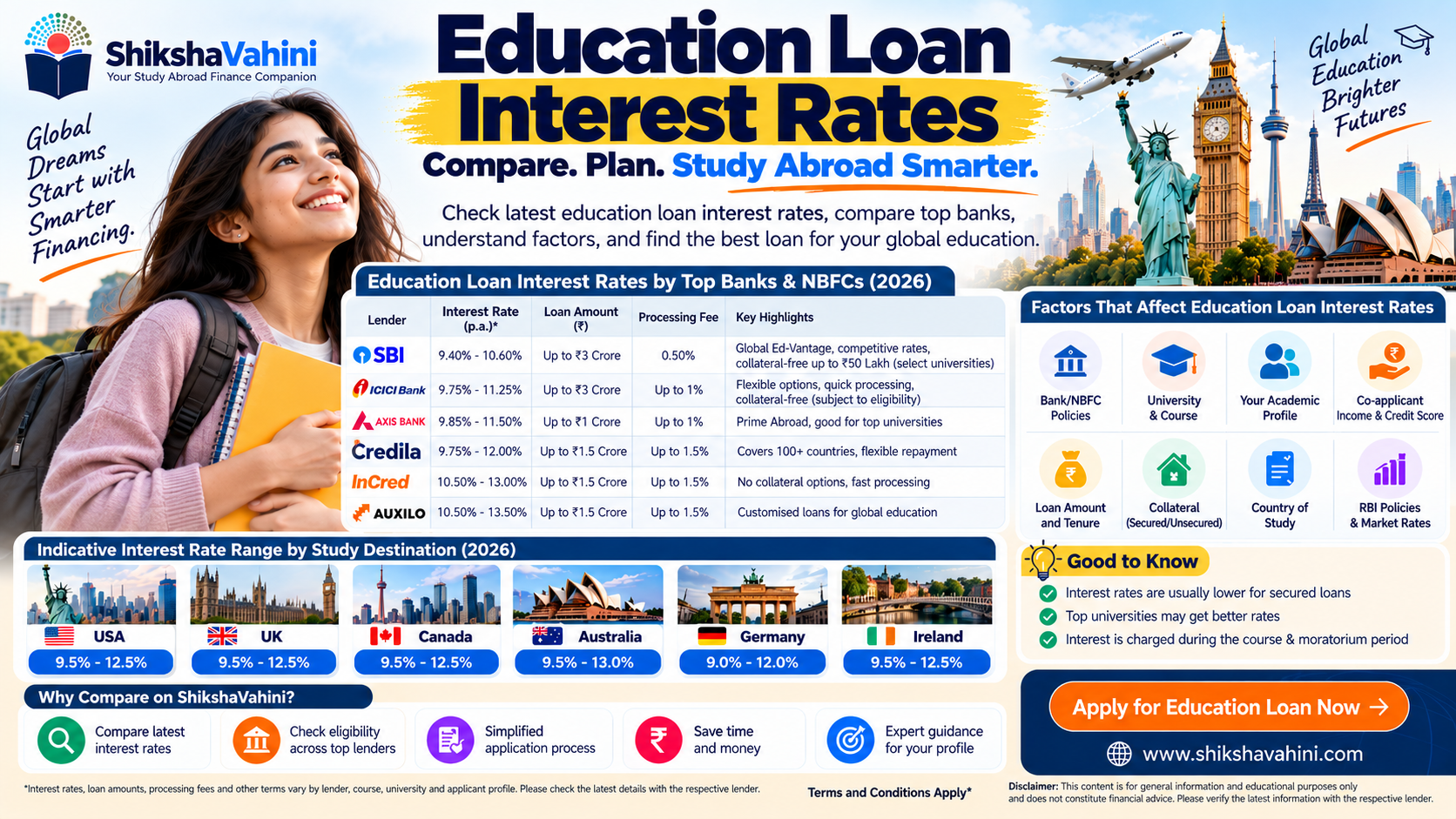
Compare education loan interest rates in India for 2026 from leading banks and NBFCs. Explore SBI, ICICI Bank and other lenders, compare secured and unsecured education loans, calculate EMI, understand processing fees, and discover tips to find the best education loan interest rate for studying in India or abroad.
Education Loan Interest Rates in India: Compare Banks, Calculate EMI & Find the Best Rate
A complete guide for Indian students planning higher education in India or abroad | Updated: October 2026
Imagine receiving your dream university's admission letter. You've worked hard for it, your family is excited, and you're ready to take the next step. Then you start comparing education loans and discover something confusing: two lenders may offer financing for the same course, yet quote different interest rates.
Even a small difference in the rate can translate into lakhs of rupees over the repayment period.
That's why choosing an education loan isn't just about finding a bank willing to fund your studies. It's about understanding the education loan interest rate, total borrowing cost, repayment terms and how each offer fits your financial situation.
In this guide, we'll explain current published education loan rates, compare leading lenders, show how interest affects your EMI, and help you make a more informed decision.
Quick answer: Education loan interest rates in India vary by lender, course, institution, loan amount, collateral, co-applicant profile and repayment terms. For overseas studies, ICICI Bank currently publishes starting rates of 9.00% p.a. for secured loans and 10.25% p.a. for unsecured loans. SBI's Global Ed-Vantage published rates include 8.90% for secured loans at select institutions and 9.40% for specified collateral-free loans, subject to scheme conditions. These are lender-published rates, not guaranteed offers.
1. What Is an Education Loan Interest Rate?
An education loan interest rate is the percentage a lender charges for borrowing money to pay for education-related expenses.
Suppose you borrow₹30 lakh at an annual interest rate of 10%.
The interest is not necessarily a flat 10% of the original amount every year throughout the loan. In a typical reducing-balance loan, interest is calculated on the outstanding principal, so the interest component generally decreases as you repay the principal.
Your actual borrowing cost depends on:
- The interest rate offered by the lender
- Whether the rate is fixed or floating
- The amount and timing of loan disbursements
- Whether interest accrues during the study period
- The repayment tenure
- Processing fees and other applicable charges
The key point: Don't compare education loans by interest rate alone. Compare the total amount you are expected to repay.
2. Latest Education Loan Interest Rates in India: Bank-Wise Comparison
The following table summarises selected rates and terms published by lenders. Rates are indicative and may change; verify the applicable rate directly with the lender before applying.
| Bank / Lender | Published Interest Rate Information | Important Conditions |
|---|---|---|
| SBI | Global Ed-Vantage: 8.90% p.a. for secured loans at select institutions; 9.40% p.a. for specified collateral-free loans | Scheme, institution and loan eligibility apply |
| ICICI Bank | Abroad studies: secured from 9.00% p.a.; unsecured from 10.25% p.a. | Depends on applicant, course, institution and credit profile |
| HDFC Bank / Credila | HDFC Bank foreign education loan page advertises secured loans starting at 9.25% p.a. | Floating rate and risk-based pricing; check the actual offer |
| Axis Bank | Floating-rate education loans; applicable rate depends on the product and loan profile | Check the current rate schedule and applicable charges |
| InCred | Individualised pricing based on the application and lender's underwriting | Confirm the current rate and fees in the written offer |
| Auxilo | Pricing depends on the applicant, programme and loan structure | Confirm the current rate and terms directly |
Sources: SBI's education-loan rate schedule, ICICI Bank's education-loan rate page, HDFC Bank's foreign education loan page and Axis Bank's published charges.
Important: The rates above are not a ranking of the cheapest lenders for every student. A lender advertising a low starting rate may not offer that rate for your course, university, loan amount or co-applicant profile.
For the latest offer, check the lender's official rate page and request a written quotation.
3. SBI Education Loan Interest Rates
The State Bank of India offers several education-loan schemes for students pursuing higher education in India and overseas.
Its Global Ed-Vantage scheme is designed for eligible students pursuing studies abroad.
According to SBI's published rate schedule, effective 9 June 2026:
- Global Ed-Vantage secured loans at select institutions: 8.90% p.a.
- Specified collateral-free loans for select institutions: 9.40% p.a.
- Other secured Global Ed-Vantage loans: 9.40% p.a.
- SBI Student Loan Scheme without collateral up to₹7.50 lakh: 9.90% p.a.
These rates are subject to SBI's scheme conditions and may change. SBI's rate schedule also states that education-loan rates are linked to its External Benchmark Rate and are floating.
When should you consider SBI?
SBI may be worth comparing if:
- You have admission to an eligible institution.
- You want to evaluate both secured and eligible collateral-free options.
- You prefer a bank loan with a published rate schedule.
- You want to compare the total repayment cost against private banks and specialist education lenders.
Before applying, confirm whether your university and course qualify for the specific scheme and whether the advertised rate applies to your loan.
Official website: SBI Education Loan Interest Rates
4. ICICI Bank Education Loan Interest Rates
ICICI Bank offers education loans for domestic and international studies.
Its published information for overseas education loans states:
- Secured loans: Starting from 9.00% p.a.
- Unsecured loans: Starting from 10.25% p.a.
The bank explains that the applicable interest rate depends on factors such as the course, institution, loan amount, loan security and applicant/co-applicant profile. Its published education-loan charges include processing fees of up to 2% of the loan amount plus GST, subject to applicable terms.
What should you check?
Ask ICICI Bank to confirm:
- 1The rate applicable to your university and course.
- 2Whether the offer is secured or unsecured.
- 3The processing fee and other charges.
- 4Whether the rate is fixed or floating.
- 5The repayment tenure and moratorium terms.
- 6Whether any rate concession applies to your profile.
Official website: ICICI Bank Education Loan Interest Rates
5. HDFC Bank and Credila: Understand the Difference
Students may encounter both HDFC Bank education-loan information and Credila while comparing financing options. It is important to identify the actual lender named in the offer.
HDFC Bank's foreign education loan page advertises secured loans starting at 9.25% p.a. and states that unsecured loans are available up to₹75 lakh, subject to eligibility. Its page describes the interest rate as floating and linked to Credila Financial Services Limited's benchmark lending rate for the relevant product.
Credila's own website advertises education loans for overseas studies, financing for tuition and living expenses, and repayment tenures of up to 15 years, subject to conditions. It describes its pricing as customised to the applicant's profile.
Credila (Formerly HDFC Credila)
Practical tip: Read the sanction letter carefully. Confirm the legal name of the lender, benchmark, spread, rate-reset terms, processing fee and repayment conditions instead of relying only on a brand name or starting rate.
Official websites: HDFC Bank Foreign Education Loan | Credila
6. What Is the Difference Between Fixed and Floating Interest Rates?
This is one of the most important decisions when choosing an education loan.
Fixed interest rate
The rate remains fixed for the period defined in your loan agreement. This can make repayment planning more predictable, but the initial rate or conversion terms may differ from a floating-rate offer.
Floating interest rate
The rate can change when the relevant benchmark or lender spread changes under the loan agreement. Your EMI, repayment tenure or both may be affected, depending on the lender's rules.
Which one is better?
A fixed rate may appeal to borrowers who prioritise predictable payments. A floating rate may be attractive if its initial pricing is competitive and the borrower is comfortable with potential changes.
Compare the written terms, not just the initial percentage.
7. Secured vs Unsecured Education Loan Interest Rates
In general, lenders may offer lower rates on some secured education loans because the loan is backed by acceptable collateral. Unsecured loans do not require the borrower to pledge property, but the lender may price the application differently to reflect its assessment of risk.
| Feature | Secured Education Loan | Unsecured Education Loan |
|---|---|---|
| Collateral | Generally required | Generally not required |
| Interest rate | May be lower | May be higher |
| Potential loan amount | May support a higher amount | Depends heavily on lender and profile |
| Documentation | Includes collateral documents | Focuses more on applicant and co-applicant profile |
| Approval | Subject to credit and collateral assessment | Subject to credit and profile assessment |
| Best suited for | Eligible applicants with acceptable security | Applicants seeking financing without pledging assets |
These are general tendencies, not universal rules. The final rate depends on the lender's product and assessment.
Remember: Don't pledge family property simply to obtain a slightly lower rate without evaluating the risks and alternative offers.
8. What Factors Affect Your Education Loan Interest Rate?
Your interest rate is not determined by one factor alone. A lender evaluates the overall application.
1. University and course
Admission to an institution recognised by the lender's scheme, or a course with strong employment prospects, may influence pricing and eligibility.
2. Secured or unsecured loan
Collateral can influence the lender's risk assessment and the rate offered.
3. Loan amount
Some lenders use different pricing structures for different loan sizes or schemes. A larger loan does not automatically guarantee a lower rate.
4. Co-applicant income and credit history
For many Indian education loans, the co-applicant's income, existing liabilities, credit repayment history and employment stability are important considerations.
5. Academic and professional profile
Academic performance, course selection and anticipated employability can form part of the lender's assessment, particularly for overseas education loans.
6. Repayment tenure
The tenure affects the EMI and total interest. The interest rate itself may also vary by product or loan structure.
7. Benchmark and lender spread
A floating rate may be linked to a benchmark plus a spread. Changes in the benchmark or contractual spread can affect the applicable rate.
The RBI explains that education-loan interest rates are determined by banks under the applicable regulatory framework rather than through one universal rate set for all lenders.
What Determines Your Education Loan Interest Rate?
YOUR EDUCATION LOAN RATE
The final offer depends on your complete application
University & Course
Institution category and programme
Collateral
Secured or unsecured structure
Co-Applicant
Income, liabilities and credit history
Lender Policy
Benchmark, spread and scheme rules
Illustration only. Each lender uses its own eligibility and pricing criteria.
9. How Much Difference Can a Small Interest-Rate Change Make?
Let's consider a₹30 lakh education loan with a repayment period of 10 years, assuming a standard monthly reducing-balance EMI calculation and repayment beginning immediately.
| Interest Rate | Approx. Monthly EMI | Approx. Total Repayment |
|---|---|---|
| 9% p.a. | ₹38,000 | ₹45.6 lakh |
| 10% p.a. | ₹39,600 | ₹47.5 lakh |
| 11% p.a. | ₹41,300 | ₹49.6 lakh |
Illustrative figures rounded to the nearest₹100 or₹0.1 lakh. They exclude fees, insurance, moratorium-period interest and any changes in floating rates.
At these assumptions, the difference between 9% and 11% is approximately₹3,300 per month—and nearly₹4 lakh in total repayments over 10 years.
That is why comparing rates before signing a loan agreement can be valuable.
10. Education Loan EMI Calculator: Estimate Your Monthly Repayment
Use this simple calculator to estimate your EMI based on your proposed loan amount, annual interest rate and repayment tenure.
**Education Loan EMI Calculator**
11. What Is an Education Loan Moratorium Period?
A moratorium is a period during which the borrower is generally not required to begin regular principal-and-interest EMI repayment under the loan's repayment schedule. It commonly covers the study period plus an additional period defined by the lender.
However, a moratorium does not automatically mean that the loan is interest-free.
Interest may accrue while you study. Depending on the lender and your repayment arrangement, unpaid interest may be added to the principal when regular repayment begins.
For example, SBI's Global Ed-Vantage information explains that simple interest applies during the course and moratorium period and that accrued interest may be added to the principal if it is not serviced during that period.
Before accepting a loan, ask the lender:
- Does interest accrue during the study period?
- Can I pay interest while studying?
- Will unpaid interest be capitalised?
- When will regular EMI repayment begin?
- What will the outstanding balance be when the moratorium ends?
These questions can help you understand the real cost of borrowing.
12. How to Get a Lower Education Loan Interest Rate
You cannot control every part of a lender's pricing, but you can improve your application and compare offers intelligently.
Step 1: Compare at least three suitable lenders
Compare the same loan amount, repayment period, collateral arrangement and disbursement assumptions. This makes the comparison more meaningful.
Step 2: Check university-specific schemes
Some lenders publish special rates for eligible institutions or programmes. Confirm your university's eligibility before relying on a headline rate.
Step 3: Strengthen your co-applicant profile
Keep income documents, bank statements and tax returns organised. Review existing debt and check for errors in the co-applicant's credit report.
Step 4: Evaluate secured and unsecured offers
If acceptable collateral is available, compare the savings in interest against the risks and costs of pledging the asset.
Step 5: Compare fees and charges
A lower rate may not be the cheapest offer if the processing fee, insurance or other charges are higher.
Step 6: Ask about concessions
Check whether any applicable concession is available based on the lender's scheme, student category or institution.
Step 7: Read the sanction letter
Confirm the interest benchmark, spread, reset frequency, repayment schedule, moratorium, processing fees and prepayment conditions in writing.
13. Education Loan Interest Rate vs Processing Fee: Don't Confuse Them
The interest rate is the cost of borrowing over time. A processing fee is a charge associated with processing the loan.
For example, if a lender charges a processing fee of 1% on a₹40 lakh loan, that fee would be₹40,000 before any applicable taxes or other charges.
A lender with a slightly lower interest rate but significantly higher fees may not necessarily be the cheaper option.
When comparing offers, calculate:
Total estimated borrowing cost = Interest + Processing fees + Other applicable charges
Also confirm whether any insurance premium is optional or mandatory for the specific product and whether it is financed as part of the loan.
14. Should You Choose the Lowest Education Loan Interest Rate?
Not automatically.
The lowest advertised rate may apply only to specific courses, universities, loan amounts or collateral arrangements. A student may receive a different rate after the lender reviews the application.
Consider these factors together:
- Applicable interest rate
- Whether the rate is fixed or floating
- Total processing fees
- Collateral requirements
- Eligible expenses
- Margin contribution
- Disbursement timing
- Moratorium treatment
- Repayment flexibility
- Prepayment conditions
- Service quality and support
The best education loan is the one that meets your funding needs at a competitive total cost and with repayment terms you understand.
15. Can You Claim a Tax Deduction on Education Loan Interest?
Section 80E of the Income Tax Act has historically provided a deduction for eligible interest paid on a qualifying education loan for higher education of self or a relative, subject to the law's conditions.
Tax treatment depends on the applicable tax regime and current law. Do not assume the deduction will be available to every borrower or under every regime. Confirm your eligibility with the latest Income Tax Department guidance or a qualified tax professional before including a tax saving in your loan calculations.
Official reference: Income Tax Department
Infographic 2: The Smart Education Loan Comparison Checklist
COMPARE BEFORE YOU APPLY
A lower rate is only one part of a better loan
01
Interest rate
Check fixed or floating pricing and the benchmark.
02
Total fees
Include processing fees, taxes and other charges.
03
Collateral & margin
Understand security requirements and own contribution.
04
Moratorium
Check when interest accrues and how it is treated.
05
Repayment
Compare tenure, EMI, prepayment and rate-reset terms.
16. How ShikshaVahini Can Help You Compare Education Loan Options
Finding the right education loan can feel overwhelming when every lender uses different eligibility criteria, interest rates and repayment structures.
ShikshaVahini aims to help students approach education financing with a clearer understanding of their requirements and available options.
Before you apply, prepare the basics:
- 1Your target country, university and course.
- 2Your total tuition and estimated living costs.
- 3Your scholarship and family contribution.
- 4The approximate loan amount you need.
- 5Your preferred collateral arrangement and repayment expectations.
Then compare lenders on the terms that matter to you—not just the headline rate.
Ready to take the next step?
Visit ShikshaVahini and click “Apply for Loan” to begin exploring education-loan options for your study plans.
The goal is not simply to get a loan. It is to finance your education in a way that supports your future without creating an avoidable financial burden.
Frequently Asked Questions About Education Loan Interest Rates
1. What is the current education loan interest rate in India?
There is no single interest rate for every education loan. Rates vary by lender, course, institution, loan amount, collateral and borrower profile. Check each lender's current official rate schedule for the latest applicable offer.
2. Which bank has the lowest education loan interest rate?
The lowest rate depends on your eligibility and the specific scheme. SBI publishes special rates for select institutions, while ICICI Bank publishes different starting rates for secured and unsecured overseas education loans. Compare the offers applicable to your own profile rather than relying only on advertised starting rates.
3. What is the SBI education loan interest rate for studying abroad?
SBI's published Global Ed-Vantage schedule includes 8.90% p.a. for secured loans at select institutions and 9.40% p.a. for specified collateral-free loans. The applicable rate depends on the scheme and eligibility conditions.
4. What is ICICI Bank's education loan interest rate for abroad studies?
ICICI Bank currently publishes starting rates of 9.00% p.a. for secured overseas education loans and 10.25% p.a. for unsecured overseas education loans. These are starting rates, not guaranteed offers.
5. Are education loan interest rates fixed or floating?
They can be fixed or floating, depending on the lender and product. Check the loan agreement to understand how the rate can change and how often it may reset.
6. Are secured education loans cheaper than unsecured loans?
They may be, because collateral can reduce the lender's risk. However, the difference depends on the lender's pricing and the applicant's profile.
7. Can I get an education loan without collateral?
Yes, some lenders offer collateral-free education loans to eligible students. The amount and interest rate depend on the lender, university, course, co-applicant profile and other criteria.
8. Does the co-applicant's CIBIL score affect my education loan interest rate?
It can. Lenders may consider the co-applicant's credit history, repayment record, income and existing liabilities when assessing the application and pricing.
9. Does the education loan interest rate change during the course?
For floating-rate loans, the applicable rate can change according to the benchmark and terms of the agreement. Ask the lender how rate changes are communicated and whether they affect the EMI, tenure or both.
10. Is interest charged during the education loan moratorium period?
Interest commonly accrues during the moratorium, although the exact treatment depends on the lender and product. Unpaid interest may be capitalised under the loan's terms.
11. Can I pay interest while studying?
Some lenders allow borrowers to service interest during the study period. Ask whether it is optional or required and how doing so affects your outstanding balance.
12. How is education loan EMI calculated?
EMI depends on the outstanding loan amount, annual interest rate and repayment tenure. Actual education-loan repayments may also be affected by phased disbursement and moratorium-period interest.
13. Does a longer repayment tenure reduce interest?
A longer tenure generally reduces the monthly EMI but can increase the total interest paid over the life of the loan, assuming the same rate and principal.
14. Are processing fees included in the education loan interest rate?
No. Processing fees and interest are separate costs. Include fees and other applicable charges when comparing the total cost of two loan offers.
15. Can I negotiate my education loan interest rate?
You can ask the lender whether a better rate or concession is available for your profile, university or loan structure. Approval depends on the lender's policy and underwriting.
16. Can I repay my education loan early?
Many lenders allow part-prepayment or foreclosure, but conditions vary. Check whether charges apply and whether the loan has any specific restrictions.
17. Can I get a tax deduction on education loan interest?
A deduction may be available under Section 80E for eligible borrowers and qualifying loans, subject to the applicable law and tax regime. Verify the current rules before claiming it.
18. How can I find the best education loan interest rate for my profile?
Compare current written offers from multiple suitable lenders. Evaluate the applicable interest rate, fees, collateral, margin, moratorium, repayment tenure and total borrowing cost.
Final Takeaway: Compare the Full Cost, Not Just the Rate
An education loan can open the door to an opportunity that might otherwise seem financially out of reach. But the decision deserves careful planning.
Before accepting any offer, understand three things:
- The rate: What interest rate will actually apply to you?
- The cost: How much interest and fees could you pay over time?
- The repayment: Can the EMI fit your likely financial circumstances after graduation?
Compare carefully, ask questions, and read the sanction letter before committing.
To explore education-loan options for your study plans, visit shikshavahini.com and click “Apply for Loan.”
Disclaimer
This article is intended for general educational and informational purposes only. It does not constitute financial, legal, tax or investment advice. Interest rates, loan limits, eligibility criteria, fees, collateral requirements, moratorium provisions and repayment terms are subject to change and vary by lender, scheme, institution, course and applicant profile. Published starting rates are indicative and are not guaranteed offers. Verify all current terms directly with the relevant lender before applying or making a financial decision.
Terms and Conditions Apply*.
FAQs
Preliminary assessment only. Final eligibility, interest rate and loan terms are determined by the lender.