
Bank Loans
Best Bank for Education Loan in India for Studying Abroad: 2026 Guide
ShikshaVahini Counselling Desk · 11 October 2026 · 9 min read
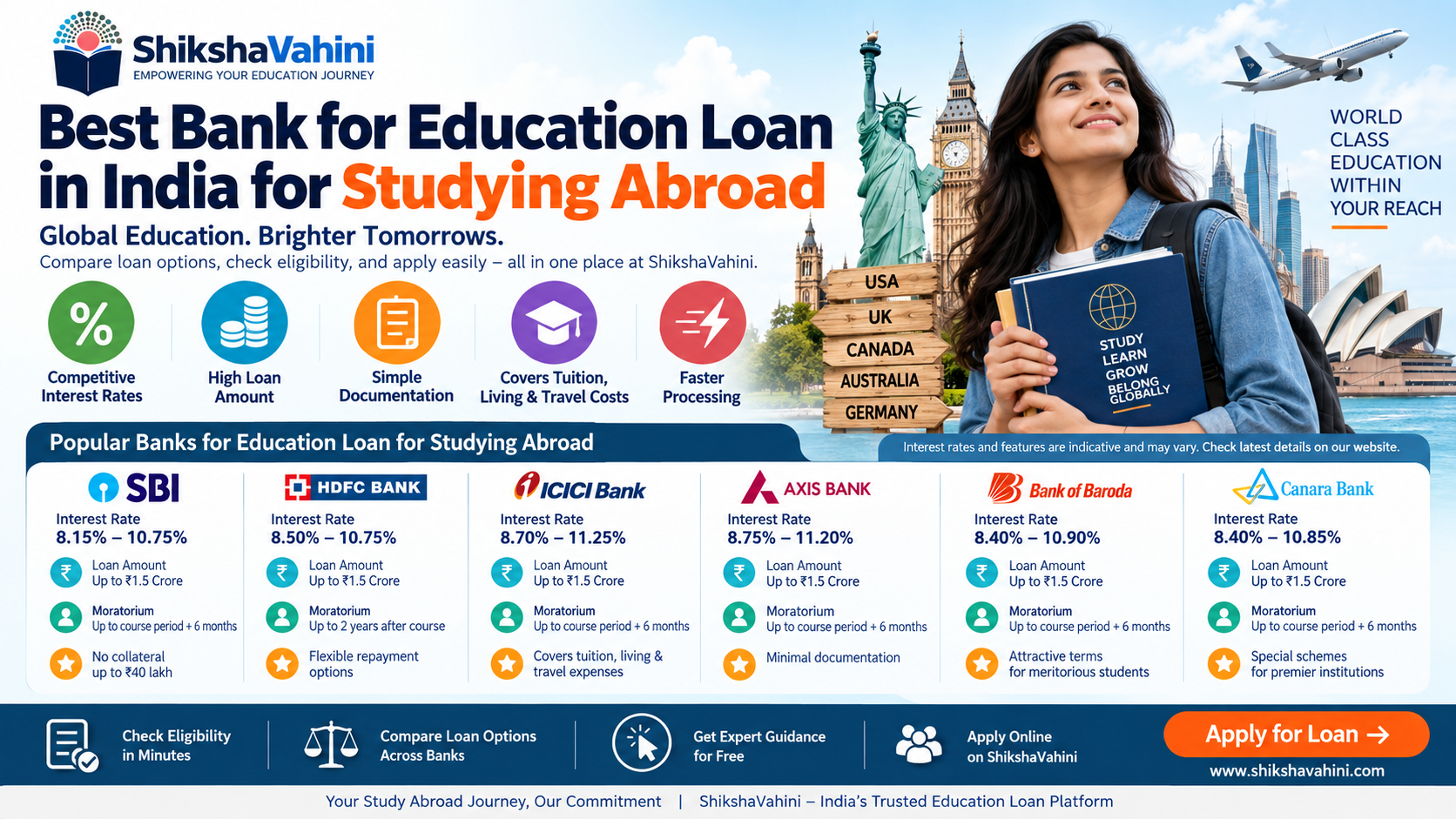
Choosing the best education loan for studying abroad is not simply about finding the lowest interest rate. Students should compare interest rates, loan amount, collateral requirements, margin money, processing fees, moratorium period, repayment tenure and prepayment terms before selecting a lender.
Best Bank for Education Loan in India for Studying Abroad: 2026 Guide
Planning to study abroad is exciting—until the university sends the fee structure. A dream MS, MBA, or postgraduate programme can quickly turn into a ₹30 lakh, ₹50 lakh, or even ₹1 crore financial commitment when tuition, accommodation, living expenses, insurance and travel are added together.
That is where an education loan can make the difference.
But choosing an education loan is not simply about finding the bank advertising the lowest interest rate. A loan at 8.5% with high margin requirements, expensive collateral formalities and unfavourable moratorium terms may ultimately cost more than a slightly higher-rate loan with better financing.
So, which is the best bank for an education loan in India for studying abroad in 2026?
The honest answer is: there is no single best bank for every student. The right lender depends on your university, country, course, loan amount, collateral availability, co-applicant profile, academic record and repayment capacity.
In this guide, we compare the major options—including SBI, Bank of Baroda, PNB, Bank of India, Canara Bank, ICICI Bank, Axis Bank and specialist education-loan lenders—and explain how to choose the right education loan for studying abroad.
Important: Education-loan interest rates, fees, eligible institutions, margins and loan limits can change. The rates mentioned below are indicative and should be verified with the lender before applying.
Quick Answer: Which Is the Best Bank for an Education Loan for Abroad Studies?
If you want the short answer:
| Student requirement | Lender worth considering |
|---|---|
| Lowest-cost public-sector option | SBI Global Ed-Vantage / other PSU bank schemes |
| High loan requirement | SBI / ICICI Bank / selected specialist lenders |
| Study at a premier foreign university | SBI Global Ed-Vantage / Bank of Baroda / PNB, subject to institution eligibility |
| Collateral-free requirement | SBI for eligible institutions, ICICI, Axis, specialist education lenders |
| Need faster processing | Private banks / specialist education lenders |
| Lower margin requirement | Compare Bank of Baroda, SBI and other PSU schemes based on institution |
| No property available as collateral | Unsecured education loan options from banks/NBFCs |
| Government-linked loan application route | Vidya Lakshmi / applicable government portals and lender channels |
The important point is that the "best education loan" is the best approved offer for your particular profile—not necessarily the lender with the lowest advertised rate.
1. SBI Education Loan – Best Overall Option for Many Students
State Bank of India is one of the first banks Indian families should evaluate when financing overseas education.
Its Global Ed-Vantage scheme is specifically designed for students pursuing full-time regular courses at foreign universities.
SBI states that Global Ed-Vantage can provide loans of up to ₹3 crore, with collateral-free financing available up to ₹50 lakh for select premier institutions, subject to eligibility. Repayment can extend up to 15 years, and SBI states that sanction/disbursement can be arranged before I-20/visa requirements in applicable cases. (State Bank of India)
SBI's published education-loan rate page lists Global Ed-Vantage rates from 8.65%–9.15% in certain categories, while rates vary according to institution, collateral and applicable concessions. The bank also lists a 0.50% concession for girl students in applicable schemes. (State Bank of India)
Why consider SBI?
- High maximum loan amount
- Dedicated overseas education product
- Collateral-free option for eligible premier institutions
- Long repayment period
- Strong presence across India
- Possibility of interest concessions
- Can finance a wide range of study-related expenses
Potential drawback
For some applicants, documentation, collateral valuation and sanction processes can take longer than specialist lenders.
Best suited for: Students targeting recognised/premier foreign universities who want a potentially lower-cost bank loan and can meet the documentation/security requirements.
2. Bank of Baroda Education Loan – A Strong PSU Alternative
Bank of Baroda offers the Baroda Scholar education loan for higher education, including overseas studies.
Its scheme differentiates between premier and non-premier institutions, and pricing is linked to the bank's benchmark and applicable spread. The bank's current published information shows different spreads depending on institution category and loan amount. (Bank of Baroda)
This is important because the university you choose can directly influence your loan terms.
Why consider Bank of Baroda?
- Dedicated education-loan scheme
- Overseas education coverage
- Different pricing for premier institutions
- Public-sector-bank structure
- Potentially attractive terms for eligible students
Best suited for: Students whose university falls within the bank's eligible/premier institution categories and families looking for a PSU-bank alternative to SBI.
3. PNB Education Loan – Worth Comparing for Overseas Studies
Punjab National Bank offers PNB Udaan for students pursuing education abroad.
PNB's published rates show that pricing can vary substantially depending on the institution, collateral and applicant category. For certain specified institutes with adequate collateral, the published floating rate is lower than its standard overseas education-loan categories. Female students can also receive preferential pricing in specified categories. (PNB India)
Why compare PNB?
- Dedicated overseas education product
- Different pricing tiers
- Female-student concessions in applicable categories
- Long repayment options
- Public-sector-bank lending
Best suited for: Students with strong academic profiles and/or adequate collateral who want to compare PSU-bank offers.
4. ICICI Bank Education Loan – Strong Option for High Funding Requirements
ICICI Bank is another major option for students planning to study abroad.
ICICI Bank currently advertises education loans of up to ₹3 crore for domestic and international studies. Its website states that overseas education loans can start from 9.00% p.a. for secured loans and 10.25% p.a. for unsecured loans, although the actual rate depends on the applicant, institution, course and loan structure. (ICICI Bank)
The bank also offers repayment tenure of up to 15 years and says that selected institutions can qualify for zero-margin financing. (ICICI Bank)
ICICI Bank can be attractive if you need:
- A high loan amount
- Overseas education financing
- Flexible repayment
- Faster digital processes
- Financing for tuition and other eligible costs
- A loan without foreclosure charges, subject to applicable terms
Best suited for: Students with substantial funding requirements who value a combination of loan size, digital processing and flexibility.
5. HDFC Bank / HDFC Credila – Important Distinction
This is an area where students frequently get confused.
The HDFC Bank website's foreign education loan page currently presents the education-loan offering through Credila Financial Services Limited, a specialist education-loan company. HDFC's page states that secured foreign-education loans start from 9.25%, while unsecured loans are available up to ₹75 lakh, subject to eligibility. (HDFC Bank)
Therefore, students should not automatically treat HDFC Bank and HDFC Credila as identical lending products.
The actual lender, sanction terms, processing fee, collateral requirements and interest rate should be checked in the sanction documentation.
Why specialist education lenders can be useful
They may provide:
- Higher unsecured loan limits
- More flexibility for overseas universities
- Faster processing
- Greater focus on education-loan underwriting
- Alternative collateral structures
But faster approval does not automatically mean cheaper borrowing.
6. Bank of India Education Loan
Bank of India offers its Star Education Loan – Studies Abroad for eligible overseas courses.
The bank states that loans can go up to ₹150 lakh under the scheme, subject to eligibility and the applicable course/institution conditions. It also specifies financing for tuition, hostel fees, examination/library fees, books, equipment, travel and other eligible education-related expenses. (Bank of India)
For overseas studies, the published margin structure includes:
- Up to ₹4 lakh: nil margin
- Above ₹4 lakh and up to ₹7.5 lakh: 15%
- Above ₹7.5 lakh: generally 10% for specified categories, subject to scheme conditions
The bank also states a repayment period of up to 15 years after commencement of repayment and a moratorium of course period plus one year. (Bank of India)
Best suited for: Students looking for another PSU-bank option, particularly where the course and university satisfy the scheme's eligibility criteria.
7. Canara Bank Education Loan
Canara Bank is another bank worth including in your comparison.
Canara Bank maintains education-loan schemes and lists overseas education-related interest-subsidy information on its website. It also has specific schemes/lists for students pursuing master's programmes at selected top-ranking foreign universities. (Canara Bank)
This is a good reminder that institution-specific schemes can sometimes be more important than the bank's general education-loan product.
The Best Bank Depends on Your Situation
This is the most useful way to approach the decision.
If you have property to offer as collateral
Start by comparing:
SBI → Bank of Baroda → PNB → Bank of India → Canara Bank → ICICI Bank
A secured loan may offer a lower interest rate than an unsecured loan.
If you don't have collateral
Compare:
SBI eligible-premier-institution option → ICICI → Axis → specialist education lenders
Do not assume that every university qualifies for the same unsecured limit.
If you need ₹50 lakh–₹1 crore+
Look beyond the headline interest rate.
Compare:
- Maximum sanctioned amount
- Collateral requirement
- Margin
- Processing fee
- Moratorium interest
- Repayment tenure
- Prepayment terms
- Disbursement schedule
A lender offering ₹70 lakh at a slightly higher rate may be more useful than a lender offering ₹30 lakh at a lower rate.
Education Loan Comparison: What Should You Actually Compare?
Here's the mistake many students make.
They Google:
"Education loan interest rate"
They see 8.5%, 9%, 10% and immediately choose the lowest number.
That's like choosing a flight solely because its ticket price is ₹2,000 cheaper—without checking baggage charges, airport, cancellation rules or whether the flight actually gets you to your destination.
For an education loan, compare the total borrowing package.
| Factor | Why it matters |
|---|---|
| Interest rate | Determines borrowing cost |
| Fixed/floating | Determines whether rate can change |
| Loan amount | Must cover the funding gap |
| Margin money | Determines how much you fund yourself |
| Collateral | Can affect rate and approval |
| Processing fee | Adds to upfront cost |
| Moratorium | Determines when repayment starts |
| Moratorium interest | Can substantially increase principal |
| Repayment tenure | Affects EMI and total interest |
| Prepayment rules | Important if you repay early |
| Institution eligibility | Can make or break approval |
| Co-applicant requirements | Affects eligibility |
| Disbursement timing | Critical for fee deadlines |
| Currency/remittance process | Important for overseas payments |
How Much Education Loan Can You Get for Studying Abroad?
There is no universal number.
The amount depends on:
- Tuition fee
- Course duration
- University
- Country
- Living expenses
- Travel expenses
- Insurance
- Academic expenses
- Applicant profile
- Co-applicant income
- Collateral
- Future earning potential
- Lender's institution list
For example, suppose your total estimated cost is:
Example
Tuition: ₹42 lakh Accommodation & living: ₹15 lakh Travel & insurance: ₹3 lakh Books/equipment/other expenses: ₹2 lakh
Total = ₹62 lakh
If you have ₹12 lakh available from savings and scholarship, your financing requirement becomes approximately:
₹62 lakh − ₹12 lakh = ₹50 lakh
But whether a bank sanctions exactly ₹50 lakh depends on its margin requirements, eligibility and assessment.
Secured vs Unsecured Education Loan for Abroad Studies
This is one of the biggest decisions students face.
Secured Education Loan
A secured loan is backed by collateral such as:
- Residential property
- Commercial property
- Fixed deposits
- Government securities
- Certain financial assets
Advantages
- Generally lower interest rate
- Higher loan amounts possible
- Better pricing for larger loans
- Potentially longer repayment
Disadvantages
- Property/security documentation
- Valuation and legal verification
- Longer processing in some cases
- Risk to the collateral if the loan defaults
Unsecured Education Loan
No property is pledged as collateral.
The lender primarily assesses:
- Student profile
- University
- Course
- Academic record
- Co-applicant income
- Credit profile
- Future earning potential
Advantages
- No property mortgage
- Faster in many cases
- Useful for families without suitable collateral
- Can be attractive for premier universities
Disadvantages
- Usually higher interest
- Lower maximum amount with some lenders
- Stronger student/co-applicant profile may be required
What Expenses Does an Education Loan for Abroad Studies Cover?
Depending on the lender and scheme, an overseas education loan may cover:
- Tuition fees
- Hostel/accommodation
- Examination fees
- Library fees
- Books
- Laptop/computer where permitted
- Equipment
- Travel expenses
- Insurance
- Living expenses
- Study-related deposits
- Other eligible educational expenses
For example, SBI's Global Ed-Vantage documentation specifically includes tuition/hostel, examination and library fees, books/equipment, eligible computer expenses, project/thesis-related costs, travel expenses and certain other costs. (State Bank of India)
ICICI Bank similarly lists tuition, examination, books, laptop, travel, living and hostel expenses among eligible expenses. (ICICI Bank)
Always ask the lender for its exact eligible-expense schedule before calculating your funding requirement.
Education Loan Eligibility for Studying Abroad
Although criteria differ between lenders, students generally need:
Student eligibility
- Indian citizenship/residency as applicable
- Admission to a recognised foreign university
- An eligible course
- Acceptable academic record
- Required entrance/language test scores where applicable
Co-applicant
The parent or guardian is commonly required as a co-borrower for Indian bank education loans.
The lender will examine:
- Income
- Employment/business stability
- Credit history
- Existing liabilities
- Banking history
- Repayment capacity
Documents Required for an Overseas Education Loan
Prepare your documents before applying.
Student documents
- Aadhaar/PAN
- Passport
- Academic mark sheets
- Degree certificates
- Admission/offer letter
- University fee structure
- Scholarship letter, if applicable
- Entrance-test scores
- IELTS/TOEFL/GRE/GMAT or other applicable scores
- Course details
- Cost-of-study estimate
Co-applicant documents
- PAN/Aadhaar
- Address proof
- Salary slips/Form 16/ITR
- Bank statements
- Employment/business documents
- Existing loan details
Collateral documents
If the loan is secured:
- Property title documents
- Previous sale deeds
- Property tax records
- Approved plans, where applicable
- Encumbrance-related documents
- Valuation/legal documents requested by the bank
Tip: Don't wait until the university's fee deadline to start the loan process.
Education Loan Process for Studying Abroad
The process usually looks like this:
Step 1: Get admission
Obtain your university offer/admission letter.
Step 2: Calculate the complete cost
Don't calculate only tuition.
Include:
Tuition + living + accommodation + insurance + travel + other eligible expenses
Step 3: Calculate your own contribution
Subtract:
- Savings
- Scholarship
- Assistantship
- Other confirmed funding
Step 4: Shortlist lenders
Ideally compare at least 3 offers.
Step 5: Check collateral requirements
Determine whether you want:
Secured loan vs unsecured loan
Step 6: Submit documents
Provide complete and accurate documents.
Step 7: Sanction
The lender assesses:
- Student
- Course
- University
- Co-applicant
- Credit profile
- Security
- Repayment capacity
Step 8: Disbursement
Funds are generally released according to the approved schedule and eligible expenses.
Infographic: How to Choose the Right Education Loan
THE 7-POINT EDUCATION LOAN CHECKLIST
1. University ↓ Is your institution on the lender's eligible list?
2. Total Cost ↓ Tuition + living + accommodation + travel + insurance
3. Loan Requirement ↓ How much do you actually need to borrow?
4. Collateral ↓ Property available or need an unsecured loan?
5. Interest Rate ↓ Compare the actual rate offered to your profile
6. Total Cost ↓ Processing fee + moratorium interest + insurance + other charges
7. Repayment ↓ Can your expected post-study income comfortably support the EMI?
Then—and only then—choose the lender.
Don't Ignore the Moratorium Period
The word "moratorium" sounds comforting.
But students sometimes misunderstand it.
A moratorium generally means repayment of principal is deferred during the eligible period. It does not necessarily mean that interest stops accumulating.
SBI, for example, states that simple interest is charged during the course and moratorium period under Global Ed-Vantage, with accrued interest added to principal for EMI repayment after the repayment holiday. (State Bank of India)
Why does this matter?
Suppose you borrow ₹50 lakh.
If interest accumulates for several years before full EMI repayment begins, your eventual outstanding amount can be considerably higher than the amount originally borrowed.
Therefore, ask every lender:
"Exactly how much will I owe when my EMI starts?"
That question is often more useful than simply asking:
"What is your interest rate?"
How to Reduce the Cost of Your Education Loan
Here are practical strategies that can save money.
1. Compare secured and unsecured offers
If you have acceptable collateral, get both quotations.
2. Negotiate
Ask whether the lender can reduce:
- Interest rate
- Processing fee
- Margin
- Insurance-related charges
3. Make interest payments during the study period if possible
Even partial servicing of interest can reduce the amount eventually capitalised, depending on the loan structure.
4. Use scholarships strategically
A scholarship isn't merely an academic achievement—it reduces your borrowing requirement.
5. Don't borrow unnecessarily
If you need ₹45 lakh, don't automatically take ₹60 lakh just because the bank approves it.
6. Compare the actual sanction letters
The advertised interest rate is not the final answer.
Your sanction letter is.
Education Loan Tax Benefit in India
Education-loan interest may qualify for a deduction under Section 80E of the Income Tax Act, subject to the applicable conditions and tax regime.
SBI and ICICI both refer to Section 80E benefits for eligible education-loan borrowers. (State Bank of India)
However, tax rules can change, and eligibility depends on the borrower and applicable tax regime.
So don't select a loan only because someone says it provides a tax benefit.
The first priority should be the overall economics of the loan.
What About PM Vidyalaxmi for Studying Abroad?
This is an important misconception.
PM Vidyalaxmi is not a general-purpose overseas education loan scheme.
The Ministry of Education's guidelines state that the PM-Vidyalaxmi education loan is for students admitted on merit to eligible Quality Higher Education Institutions (QHEIs) in India. Foreign education institutions are not covered. (Education Government)
Therefore:
If you are going to the USA, UK, Canada, Australia, Germany or another foreign country, don't assume that PM Vidyalaxmi will finance your overseas university.
Instead, look at the applicable overseas education-loan schemes of banks and other lenders.
This distinction is particularly important because many websites loosely use the terms "Vidya Lakshmi", "PM Vidyalaxmi" and "education loan portal" interchangeably.
Vidya Lakshmi Portal vs PM Vidyalaxmi Scheme
Another common source of confusion:
Vidya Lakshmi
A government-supported digital platform through which students can apply for education loans offered by participating banks.
PM Vidyalaxmi
A specific government scheme providing benefits for eligible students studying in eligible QHEIs in India.
They are not the same thing.
Always check which scheme/product you are actually applying under.
Bank vs NBFC: Which Is Better for Study Abroad?
There is no universal winner.
Banks
Pros
- Often competitive interest rates
- Strong regulatory framework
- Established banking infrastructure
- Potentially attractive secured-loan pricing
Cons
- Documentation may be extensive
- Collateral processes can take time
- Institution/course eligibility may be stricter
Specialist education lenders/NBFCs
Pros
- Faster processing in many cases
- Specialist underwriting
- Higher unsecured limits may be available
- Greater flexibility for certain foreign universities
Cons
- Interest may be higher
- Processing charges can be significant
- Loan terms vary substantially between lenders
Our advice
Don't ask:
"Bank or NBFC?"
Ask:
"Which lender gives me the lowest total borrowing cost while meeting my funding requirement and university deadline?"
That's the better question.
5 Mistakes Students Should Avoid
Mistake 1: Choosing only on interest rate
A 0.5% lower rate does not automatically mean a cheaper loan.
Mistake 2: Ignoring margin money
A ₹50 lakh loan with a 15% margin can require a significant upfront contribution.
Mistake 3: Waiting until the visa stage
Education loans can involve documentation, verification, collateral valuation and sanction.
Start early.
Mistake 4: Borrowing more than necessary
The bank's maximum eligibility is not your recommended borrowing amount.
Mistake 5: Not comparing the sanction letters
Two lenders can quote similar interest rates but have very different:
- Fees
- Margins
- Insurance
- Moratorium treatment
- Collateral requirements
- Repayment conditions
A Simple Example: Why the "Lowest Rate" Isn't Always Best
Imagine two lenders offer you a ₹50 lakh loan.
Bank A
- Interest: 9.0%
- Processing fee: ₹10,000
- Lower margin
- Straightforward repayment
Lender B
- Interest: 8.5%
- Processing fee: ₹75,000
- Higher margin
- Additional charges
- More complicated disbursement
At first glance, Lender B looks cheaper.
But if you have to bring several additional lakh rupees from your own pocket because of the higher margin, the cheaper advertised rate may not actually solve your funding problem.
This is why education-loan comparison must be based on the complete loan structure.
So, Which Is the Best Bank for Education Loan in India for Studying Abroad?
If we had to create a practical shortlist, it would look like this:
SBI
Best overall starting point for many students
Particularly attractive for students eligible under Global Ed-Vantage, including those targeting premier institutions.
Bank of Baroda
Strong PSU alternative
Worth checking especially when the university qualifies under its premier-institution categories.
ICICI Bank
Strong option for high loan requirements and flexible processing
Particularly worth comparing for larger overseas education requirements.
PNB
Worth comparing for eligible foreign universities and secured loans
Bank of India
Strong traditional education-loan option
Offers overseas-study financing and substantial loan limits under its applicable scheme.
Canara Bank
Worth checking for eligible overseas programmes/institutions
Axis Bank
Another option for students seeking private-bank financing
Specialist education lenders
Potentially useful when unsecured funding, speed or flexibility is the priority
The Smartest Way to Choose Your Education Loan
Imagine three students.
Student A
Has a ₹60 lakh requirement and a good property available as collateral.
A PSU-bank secured loan may be extremely attractive.
Student B
Needs ₹45 lakh but has no property.
An unsecured loan from a bank or specialist education lender may be more appropriate.
Student C
Has admission to a premier university and needs ₹30 lakh.
A lender's premier-institution category could dramatically change the available terms.
Same country.
Same dream.
Different financial solution.
That's why there is no universal "best education loan."
Before You Apply, Ask These 12 Questions
Save this checklist.
- 1What is the actual interest rate offered to me?
- 2Is the rate fixed or floating?
- 3What is the maximum loan amount?
- 4How much margin money do I need?
- 5Is collateral required?
- 6What happens during the moratorium period?
- 7Is interest simple or compounded during the moratorium?
- 8What is the processing fee?
- 9Are insurance charges compulsory?
- 10What is the maximum repayment period?
- 11Are there prepayment/foreclosure charges?
- 12Can the bank disburse funds according to my university's fee schedule?
If a lender cannot clearly answer these questions, don't sign immediately.
Why Compare Education Loans Through ShikshaVahini?
Choosing an education loan can feel like trying to compare ten different currencies at once.
Different banks use different:
- Interest-rate structures
- University lists
- Collateral rules
- Margins
- Processing charges
- Repayment conditions
ShikshaVahini is designed to make this process easier.
Instead of spending days visiting branches and trying to understand different loan products yourself, you can start by evaluating your requirements, comparing suitable loan options and moving towards the application process.
Your education loan should support your career—not become a financial burden.
That's why the right approach is:
Compare → Understand → Choose → Apply
👉 Visit ShikshaVahini and click "Apply for Loan" to get started.
Frequently Asked Questions
1. Which is the best bank for an education loan to study abroad?
There is no single best bank. SBI, Bank of Baroda, PNB, ICICI Bank, Bank of India, Canara Bank, Axis Bank and specialist education lenders can all be suitable depending on your university, loan amount, collateral and profile.
For many students, SBI Global Ed-Vantage is an excellent starting point for comparison because it is specifically designed for overseas education and offers loans up to ₹3 crore under the published scheme. (State Bank of India)
2. Which bank gives the lowest interest rate for an education loan abroad?
There is no single rate applicable to every student.
The interest rate depends on factors such as:
- University
- Course
- Loan amount
- Collateral
- Co-applicant
- Credit profile
- Lender category
Always compare the personalised rate in the sanction letter, not just the "starting from" rate advertised online.
3. Can I get an education loan for studying abroad without collateral?
Yes, in some cases.
Certain banks and specialist lenders offer unsecured education loans, particularly for students admitted to selected premier institutions. SBI, for example, states that Global Ed-Vantage provides collateral-free loans up to ₹50 lakh for select premier institutions, subject to eligibility. (State Bank of India)
4. How much education loan can I get for studying abroad?
It depends on your lender, university, course, expenses, collateral and financial profile.
Some lenders offer loans of several crores for eligible overseas programmes. ICICI Bank and SBI currently advertise maximum loan amounts of up to ₹3 crore under their respective overseas education offerings. (ICICI Bank)
5. Can I get an education loan for living expenses abroad?
Yes, eligible living and accommodation expenses can form part of an education loan, subject to the lender's scheme.
For example, ICICI Bank lists living expenses and hostel charges among eligible expenses, while SBI's published documentation includes several education-related and travel expenses. (ICICI Bank)
6. Can I get an education loan without a co-applicant?
Traditional Indian bank education loans commonly require a parent/guardian or other eligible co-borrower.
Some specialist international education lenders may have different structures.
Therefore, if you do not have a suitable co-applicant, your lender choices may be narrower.
7. Does an education loan cover visa expenses and travel?
Eligible travel expenses can be included under some overseas education-loan schemes. SBI and Bank of India, for example, specifically mention travel/passage expenses in their published scheme information. (State Bank of India)
Other visa-related costs depend on the lender's policy.
8. Can I get an education loan before receiving my visa?
In some cases, yes.
SBI states that Global Ed-Vantage can facilitate loan sanction/disbursement before I-20/visa requirements in applicable circumstances. (State Bank of India)
Students should confirm the exact documentation required by both the lender and the visa authorities.
9. Is PM Vidyalaxmi available for foreign universities?
No, not generally.
The PM-Vidyalaxmi education-loan scheme is designed for eligible Quality Higher Education Institutions in India. The Ministry's documentation explicitly excludes foreign education institutions. (Education Government)
10. Is an education loan better than using personal savings?
Usually, the answer depends on the family's financial position.
A balanced approach can sometimes be better than either extreme.
For example:
Savings + scholarship + education loan
may allow you to preserve an emergency fund while avoiding excessive borrowing.
11. Can I repay my education loan early?
Many lenders permit prepayment, but the applicable charges and conditions vary.
ICICI Bank currently states that it has no foreclosure charges on its education loan, subject to applicable terms. HDFC's foreign education-loan page also lists prepayment charges as nil. (ICICI Bank)
Always verify the terms applicable to your specific sanction.
12. When should I apply for an education loan?
As early as possible after receiving your admission offer.
Don't wait until your university's fee deadline or visa appointment is only a few days away.
A better sequence is:
Admission → Cost calculation → Loan comparison → Application → Sanction → Visa/fee planning → Disbursement
Final Takeaway
An overseas education loan is not just a source of money.
It is a long-term financial commitment that can stay with you for many years after graduation.
So don't choose a lender because a website says it is "No. 1."
Don't choose because the advertised rate looks attractive.
And don't choose simply because your friend used the same bank.
Instead, compare the actual loan offered to you on:
Interest rate + margin + collateral + processing fee + moratorium interest + repayment period + prepayment terms + total funding requirement.
For many students, SBI Global Ed-Vantage is an excellent starting point, while Bank of Baroda, PNB, Bank of India, Canara Bank, ICICI Bank, Axis Bank and specialist education lenders deserve comparison depending on the student's profile.
The smartest student isn't necessarily the one who gets the biggest loan.
It is the one who gets the right loan at the right cost.
Ready to compare your education-loan options?
Visit ShikshaVahini, explore the available options and click "Apply for Loan" to take the next step toward your study-abroad journey.
FAQs
Preliminary assessment only. Final eligibility, interest rate and loan terms are determined by the lender.